

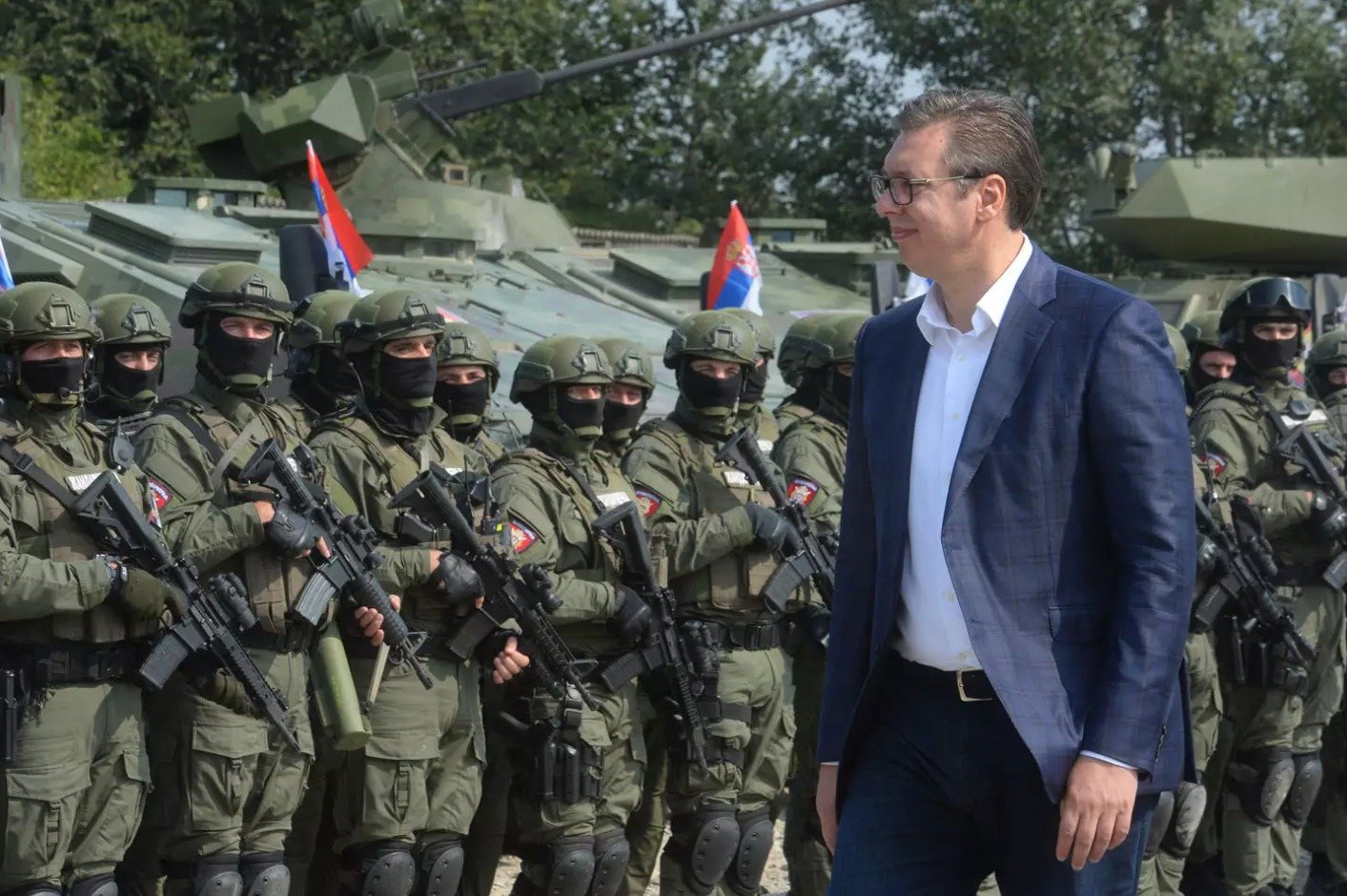
The concentration of Aleksandar Vucic’s power over the army and the security apparatus is bringing back to the Balkans the dangerous logic of the 1990s, creating direct tensions for Kosovo and challenging NATO’s stabilizing role in the region.
The politicization of the military, its authoritarian centralization, and nationalist rhetoric form a model similar to that of Milosevic, but wrapped in modern diplomacy. By expanding military cooperation with China and deepening geopolitical alignment with Russia, Serbia is becoming an increasingly serious threat to the countries of the region, while against Kosovo it continues hegemonistic propaganda and destabilizing mechanisms through political structures and criminal gangs in the north.
Author: Ridvan Emini PhD. Cand.
Researcher at Institute for Hybrid Warfare Studies “OCTOPUS”
One of the protagonists of the ‘Sarajevo Safari,’ the former minister of Slobodan Milosevic and now president of Serbia, Aleksandar Vucic, has recently been fully engaging in strengthening his grip on power by bringing the army and the security system under complete control. He is reproducing the patterns of past authoritarian regimes, especially that of Milosevis, under whose rule he grew up and was politically shaped.
According to international media and the few independent outlets in Belgrade, Vucic is building personal control over the military.
The Austrian media outlet Austrian Daily describes it as a modus operandi similar to Milosevic’s, with command centralization, politicization of the military and police, and the portrayal of the leader as the “protector of the nation”.
The few critics of Vucic in Belgrade point out that through legal changes and public rhetoric, he is turning the army into a political instrument for maintaining his own power. According to them, the entire process clearly shows that “Vucic is taking over the army and the police just like Milosevic once did”.
A member of the presidency of the party Stranka Srbija Center (SRCE), Boshko Shindic, has also stated that with this process, Vucic is preparing for a “total dictatorship”. Shindic’s concern appears to be that Vucic is clearly stripping institutions of their competencies on one hand, while on the other hand transferring those competencies to his own office (the presidency).
The drafting of new laws clearly eliminates civilian control over the army, with political decisions being made without transparency, while power is “rising on fear and not on law.” All of this, according to SRCE, is a preparatory phase for a full political dictatorship that would be administered through the apparatus of the security forces at all levels.
Just as during 1998–2000, when Milošević used the army to control protests, the same is now being attempted by his former minister of propaganda, Vucic.
However, beyond the internal plan, the protagonist of the ‘Sarajevo Safari’ appears to be playing a double rhetorical game, where through discourse he claims they want to join the European Union, while in practice he does the opposite, steering the country toward full autocracy.
In a public statement, Vucic said: “We must all join the EU”, but this contradicts first and foremost his stance toward Kosovo, then the politicization of the army, the authoritarian centralization of power, the conflict with EU institutions over rule of law, and the significant closeness to Russia and China.
This, Serbia “officially” seeks the EU, but in practice follows Putin’s Russian model.
Kosovo – the “reason” for the “Vrhovni komandant”
The former Chief of the General Staff, now MP and leader of the opposition party Stranka Srbija Center (SRCE), Zdravko Ponos, along with political scientist Cvijetin Milivojevic and independent Serbian jurists, consider that the Constitution of Serbia does not recognize the title “Vrhovni komandant” (Supreme Commander). According to them, this is a political construct with no legal basis and no parliamentary oversight, modeled on the regimes of Milosevic and Putin, with the ultimate goal of using it to create a cult of the leader. It should be recalled that at the beginning of his rule, Milosevic exerted extraordinary influence over state media, and one of the television advertisements in Serbia at that time was “vozhd je stigao” (the leader has arrived), directly referring to Milosevic himself.
Ponos believes that the new changes in the army create institutional confusion, increase the risk of abuse of power, and prepare the ground for individual decision-making in crisis situations.
Thus, beyond the personal dependency (on Vucic), from a legal standpoint the influence of the head of state over appointments, promotions, and operational command is being expanded.
Serbia has the right to conduct military exercises with any country, including China, but Vucic’s rhetoric, his alignment with Russia, and political tensions with the West make the situation deeply problematic and in contradiction with Serbia’s official orientation toward the EU.
Regarding this, NATO Secretary Mark Rutte stated in an interview with RFE that “I would distance myself from what he is doing with China.”
According to media close to the Military Academy and conservative circles, Serbia is allegedly under threat (from Kosovo, NATO, and the West), and therefore needs a “strong commander.”
This is the classic justification of authoritarian eras.
The only real difference appears to be that Vucic hides his authoritarianism behind the narrative of “stability” and “geopolitical balancing”, whereas Milosevic exercised it openly.
Throughout 2025, Serbia has clearly deepened its military relations with China through joint exercises, the purchase of drones and other military-technological equipment, and strategic cooperation in the security field.
Serbia’s orientation seems to have three objectives: strengthening the army with technology not dependent on NATO, preventing at any cost the Euro-Atlantic integration of the Republic of Kosovo by presenting Serbia as an unpredictable factor, and creating a strategic balance to keep the West under tension.
Therefore, in relation to Kosovo, Serbia is following the 1990s security model, but in more sophisticated forms such as diplomatic pressure and coded military threats, the use of the Serbian List to fuel internal destabilization, frequent military drills near the border, and rhetoric about “protecting the Serbian people”.
Consequently, Belgrade is using the narrative on Kosovo in discourse for three purposes: mobilizing domestic opinion by claiming that the country and the Serbian people are “in danger from Albanians,” legitimizing the president’s expanding power under the pretext that “only Vučić can prevent war,” and justifying closeness with Russia and China by framing it as “the West is against Serbian interests”.
This is almost identical to Milošević’s strategy during the years 1998–1999, but wrapped in modern diplomacy.
The risks to regional security and peace from Vučić’s instrumentalization of the military
The instrumentalization of the army by Vucic is not only a matter of consolidating internal power. This instrumentalization has direct and interconnected implications for the security situation in Kosovo, for the stability of the Balkans, for relations with NATO, and for the geopolitical alignment of the region itself.
The centralization of the armed forces in Vucic’s hands, outside democratic mechanisms of civilian oversight, inevitably creates an unstable security architecture, one that resembles the models of authoritarian regimes in the East.
Turning the army into a political instrument increases the likelihood that it will be used to generate premeditated and orchestrated tensions at border points; the continuous exercises near the border with Kosovo take on the character of “signaling force”, and controlled incidents can also be created to reinforce the leader’s narrative. Vučić’s regime has continually “tested” the reaction of KFOR through the deployment of troops near the border, false alarms about “threats,” and declarations of states of danger.
Thus, through various military and gendarmerie actions near—and even inside—the territory of Kosovo, Serbia has openly displayed the use of these mechanisms as instruments of negotiation either in Brussels (with the EU and Kosovo) within the dialogue framework, or with the United States.
The risk of “raising tensions” – a survival strategy for regimes
Vučić’s open tendency to control the army as the “Vrhovni komandant” is also a strategy for the survival of his regime in the face of student protests that have been ongoing for a long time, but not only that. Such a strategy has also been used by Russia in Transnistria, Abkhazia, South Ossetia, and Donbas before 2022 to deliberately prolong frozen conflicts.
Consequently, through these models, Serbia can keep the situation tense in northern Kosovo as well as in the entity of Republika Srpska (RS) and Montenegro, engaging in “undeclared” operations like the one in Banjska, or supporting radical Serbian groups, or using the Serbian Orthodox Church to create instability. Let us recall that in July 2024 a political declaration was issued in the name of the Assembly and Government and the RS entity, signed by Vucic and Dodik, under the name “Declaration on the common future of the Serbian nation”. The declaration was initially issued in the name of the so-called “All-Serb Unity Assembly”. It is clear, there for, that all operational actions on the ground that undermine the statehood of Western Balkan countries and violate their territorial integrity are part of a political program. And as can be seen, the old terminology of “Greater Serbia”, “All Serbs in one state”, “The Serbian World”, “Slavic brotherhood” appears in this declaration under the camouflage of phrases referring to the common future of the Serbian nation.
NATO Secretary Rutte, before the meeting of the Foreign Ministers of the alliance member states, stated that Serbia must hold accountable the perpetrators of the Banjska attack.
In conclusion, it can be said that Kosovo, NATO, and Western states must increase the monitoring of Serbian military activities, especially near the border with Kosovo, as well as monitoring the expansion of Serbia’s intelligence capabilities.
There should be conditioning of Serbia’s European progress by the EU and the US, linking every step forward by Belgrade to the depoliticization and decentralization of the army and distancing from Russia and China.
On the other hand, Kosovo should use its legal mechanisms for legal, political, and sanctions measures against the actors of the Serbian List who incite tensions in the country; it should also strengthen modern defensive capacities as a counterweight to the advanced Chinese technology that Serbia continues to purchase.