
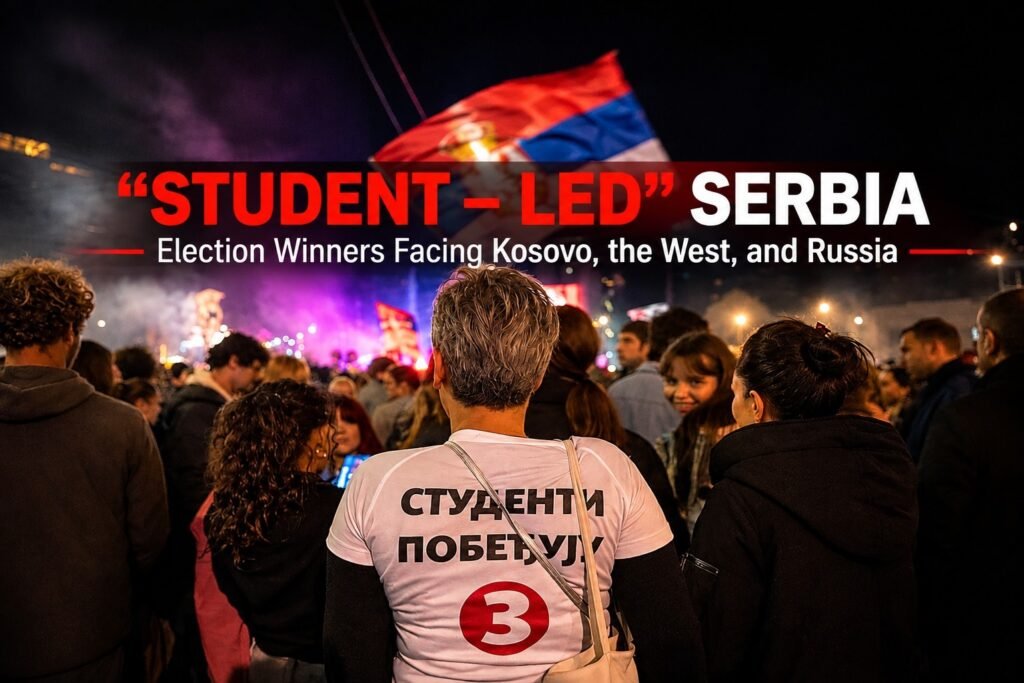
Election Winners Facing Kosovo, the West, and Russia
Author: Gjon Culaj – External Associate at the “Octopus” Institute
The victory of the Student List in the early parliamentary elections (25/10/2026) marked the symbolic end of Milošević’s political legacy, but left open the question of whether it would also mark the end of his hegemonistic policies. According to the results of the Republic Electoral Commission, the Student List won 53.01 percent of the vote and a substantial majority of 140 seats in Parliament, bringing an end to Aleksandar Vučić’s long-standing autocratic regime, whose electoral list received 38.98 percent of the vote (RIK, 03/11/2026).
However, can the significance of this victory be measured solely by the change in power?
The main dilemma facing the new government concerns the direction Serbia will take in its foreign policy. Regardless of whether the student coalition can deliver a ‘democratic transformation’, it faces a long list of challenges relating to Kosovo, nationalist rhetoric, European integration and sanctions against Russia (Reuters, 26/10/2026).
The Strategic Dilemmas of Political Turnover
Political turnover is an important first step, but it is not sufficient to ensure a democratic Serbia. Sustainable transformation requires a substantive change in Serbia’s stance towards Kosovo, as well as a break with the political legacy of conflict, insecurity, and regional tensions. Therefore, Serbia’s democratization cannot be measured solely by the quality of its domestic democracy, but also by its approach to normalizing relations with Kosovo through mutual recognition, as a prerequisite for an order based on dialogue and lasting peace. Without these changes, there is a risk that the new political elite will inherit the same patterns of governance as its predecessors, which have hindered Serbia’s internal democratization and the consolidation of regional stability (Bonomi, 26/10/2026). In the theory of democratic transition, a change in governing actors represents only one of the possible stages of political change (Lachapelle & Hellmeier, 2024:123). As Thomas Carothers (2002) argues in his article “The End of the Transition Paradigm”, political transition is not a linear path, because the opening of a political system may be followed by democratic consolidation, but may also be accompanied by resistance, institutional deadlock or a return to authoritarian practices (Carothers, 2002:17).
The winning list in Serbia has emerged as a broad civic alliance, united primarily around the fight against crime, corruption and the previous model of governance. This undoubtedly gives it considerable legitimacy, but does not guarantee political cohesion in the exercise of power, given that its members and supporters hold significantly different political views on European integration, Kosovo and relations with Russia. In their research article “Narrowing the Legitimacy Gap: Turnovers as a Cause of Democratic Consolidation”, Devra C. Moehler and Staffan I. Lindberg argue that consolidated democracy requires the independence of state institutions as legitimate mechanisms for resolving political conflicts. As these authors emphasizes, holding elections and replacing the governing elite are not sufficient to consolidate democracy (Moehler & Lindberg, 2009:1448). This is where the main contradiction surrounding the Student List becomes apparent. It received electoral support through its criticism of the former system, while, on foreign policy issues, have shown continuity with traditional Serbian nationalism (Bertuzzi, 2026). Analyses of the Student Movement have highlighted its heterogeneous composition,
bringing together pro-European, conservative and nationalist currents, making it difficult to interpret its electoral victory as an endorsement of liberal democracy (Ivanovic, 2026).
Kosovo as a Test of Political Orientation
The Student List’s electoral victory has important implications for Kosovo and must be viewed in the wider context of regional geopolitics, rather than simply as a symbolism of generational shift in Serbian politics. While the movement emerged as an alternative to the former regime, its positions on Kosovo suggest that a change of government does not necessarily entail a shift in the framework through which Serbia engages its relations with neighboring countries. For the victorious Student List, Kosovo remains an important test of whether it can translate civic mobilization into domestic transformation and a foreign policy based on dialogue and regional responsibility, or whether it will maintain nationalist rhetoric, as reflected by its statements before and during the election campaign. An important indication of this position can be found in the “Memorandum on Kosovo and Metohija” (17/05/2026), which describes Kosovo as an “integral part of Serbia and an essential element of Serbian national identity” (N1, 17/05/2026). By maintaining this position, Serbia continues to frame Kosovo primarily as a territorial and national issue instead of treating the issue as part of a political process aimed at normalizing relations through dialogue. Such a position makes a change in Serbia’s policy towards Kosovo considerably more difficult.
This is where the central contradiction within the Serbian Student Movement becomes apparent. On the one hand, it calls for accountability, the rule of law and a transformation of political culture, on the other, it continues to rely on nationalist rhetoric and territorial claims over Kosovo (Komarčević, 19/05/2026. Given Serbia’s domestic political context, such ambiguity could be interpreted as an electoral calculation aimed at maintaining a broad coalition of groups with different political convictions. Following its electoral victory, however, this ambiguity becomes an indication of the
possible continuation of hegemonic policies that threaten regional peace. The hostile statements
made by some of its representatives even after the elections further reinforce the second option. Dejan Šoškić, one of the Student Movement’s candidates for Prime Minister, told Euronews (29/10/2026) that “the new government will consider Kosovo, in accordance with the Constitution of Serbia, as its autonomous province”. Taking an even more hardline position, in line with Dačić’s rhetoric and the now defeated former regime, Radomir Saičić, one of the prominent figures in the Student Movement, described Kosovo as a “temporarily occupied territory” (Ivanovic, 2026).
The “Students” Between the EU and Russia
The Student List’s position on Russia largely reflects the approach adopted by the previous government. According to Tomasz Zornaczuk (2026), the movement has yet to adopt a clear position on EU membership, while it has openly and unequivocally opposed sanctions against Russia. Its composition is heterogeneous, bringing together different political orientations, ranging from supporters of European integration to nationalists advocating even closer ties with Russia (Zornaczuk, 2026). The main concern arising from this ambiguity is the possibility that Serbia will continue its policy of balancing between competing geopolitical interests rather than making a clear shift towards a new strategic orientation. Such positions suggest that a change of government does not necessarily lead to a reassessment of geopolitical priorities. Instead, the language of democratic reform may serve to disguise the continuation of a foreign policy shaped by the same strategic calculations that guided the previous government.
Serbia’s relations with Russia, however are shaped not only by historical, religious and cultural ties, but also by strategic interests, particularly energy security and Moscow’s support for Belgrade’s position on Kosovo. This dependence creates an important strategic dilemma: the closer Belgrade remains to Moscow, the more difficult it becomes to align its policies with the standards and positions of the European Union. Brussels should no longer overlook Serbia’s ambiguous position and should press Belgrade to clarify its path towards European integration. A lack of commitment toward this direction should have political and economic consequences. Otherwise, Serbia’s continued balancing between Moscow and Brussels risks becoming a strategic instrument that serves Russia’s revisionist interests. For the Student Movement to prove its commitment to a democratic Serbia, one of its first priorities should be ensuring that Milan Radoičić is held accountable before the law for his involvement in criminal and terrorist acts. Such a step would also require an end to policies that fuel tensions in Kosovo, a more realistic approach to the normalization process, a clear break with Russian and Chinese influence, and a willingness to confront the criminal legacy of the 1990s. Otherwise, Serbia risks once again remaining a hostage to its past and a potential threat to regional peace and security.