

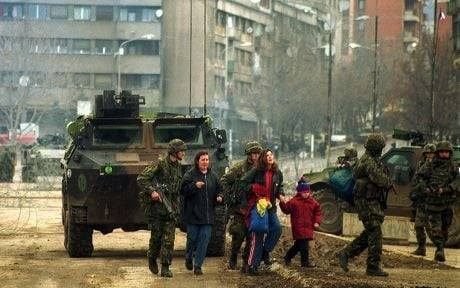
Today, 26 years ago, an organized attack, disguised as “hooliganism,” terrorized Albanians in the north of Mitrovica inside their own homes, using bombs, sniper rifles, automatic weapons, and other arms, under the “watch” of UNMIK Police and French KFOR troops.
What witnesses describe as the “night of terror,” between 3 and 4 February 2000, was a “civilian” operation of ethnic persecution through brutal violence and the destruction of homes, leaving 10 people dead, including women, children, and the elderly, 25 wounded, and 93 physically abused. Yet another massacre against Albanians, in order to achieve the planned “result”: their expulsion from the north, accompanied by the criminals’ chant “no Albanians in the north.”
After the failure of Operation “Horseshoe” to ethnically cleanse Kosovo due to NATO’s intervention and Serbia’s capitulation on 9 June 1999 in Kumanovo, Milosevic’s machinery “ordered” the operation of ethnic cleansing of the north, as revenge and as a new political strategy. Today, 26 years later, the “night of terror” remains a documented crime awaiting an indictment.
The Scenario for the “Securitization” of the North
On 3 and 4 February 2000 in northern Mitrovica, the “Bridge Watchers” attacked, destroyed, and burned Albanian homes, leaving people killed, wounded, and physically abused, as a planned method of terror to force them to leave. Twelve thousand Albanians crossed overnight to the southern part of the city, in the presence of international forces, which seemed to be “tolerating” the scenario of the “securitization” of the north.
A scenario that would convert the north into a special security zone and determine the further course of the battle for Kosovo: on one side, Albanians and other minority communities striving for a “state for all” in coordination with the international community; on the other, Serbia and its allies, undermining Euro-Atlantic efforts by using hybrid methods for the Serbization of the north and for partition as a political objective.
KFOR’s approach of maintaining stability, avoiding confrontation, and gradually integrating Serbs was exploited as space for consolidation, arming, and the “institutionalization” of Serbia’s illegal structures. Serbia misused this approach, interpreting it as a “license” to advance its expansionist project.
The “Ibar Bridge,” transformed into a symbol of division, as well as all subsequent developments, demonstrate that the “night of terror” was the first operation toward hybrid structures aimed at sabotaging Kosovo—culminating years later with the failed incursion in Banjska (Zvečan) in 2023 and the terrorist attack on the Ibër-Lepenc canal in 2024.
From a security perspective, all actions of these structures in the north—including violent protests, attacks on internationals, road blockades, fabrication of lies, inciting narratives, instrumentalization of Serbian citizens, and influence operations, have been tools of Serbia’s strategy of “victimization,” aimed at pressuring Kosovo and undermining it as a “state of all citizens.”
Justice in the Pool of the Unknown
As in Kafka’s The Trial, the Mitrovica massacre is a crime that exists in hundreds of images, survivor testimonies, and investigations, yet still has no accused.
On 11 August 2014, an International Prosecutor filed an indictment against Oliver Ivanović, Aleksandar Lazović, Dragoljub Delibasić, and Ilija and Nebojsa Vujacić for war crimes against the civilian population in April 1999 and February 2000, but after a thirteen-month review, the trial panel chaired by Judge Roxana Comsa found only Ivanović guilty of the first charge (21 January 2016), while acquitting him and the others of the second charge. In October 2016, the Court of Appeal ordered a retrial, but on 16 January 2018 Ivanović was assassinated in front of his office in North Mitrovica.
Thus, this was the only judicial process that included the crimes of 3 and 4 February 2000—but not one that identified those responsible. On the occasion of the 25th anniversary of the Mitrovica victims, Prime Minister Kurti announced that he had sent an official letter to the EU High Representative for Foreign Affairs and Security Policy, Kaja Kallas, requesting a full and comprehensive investigation to identify and prosecute those responsible. The response: none.
Commemorations and calls for justice continue to drown in the pool of the unknown regarding the events that determined the course of the new battle for Kosovo. Therefore, the message of the “night of terror” in Mitrovica still threatens, still has not received a proper response.
Not until the perpetrators are punished, and not until Serbia understands that “Maja e Madhe” is Kosovo.