

Gjon Culaj, Associate Fellow at the “Octopus” Institute
At a time of global uncertainty, when the world is facing successive crises such as Russian aggression in Ukraine, strategic rivalry with China, and instability in the Middle East, the Munich Security Conference (MSC-2026) presented a clear picture of the state and challenges of transatlantic relations. Where the discourse once revolved around unwavering unity between the United States and Europe, today the debate has shifted toward strategic balance, the consolidation of European autonomy, and the politico-military resilience of the Western alliance.
In this context, relations between the United States and the European Union can no longer be reduced, as they once were, to the traditional partnership in the field of security, but are increasingly viewed as a test of political, economic, and military capabilities to adapt to a fragmented and evolving international order. While Washington is calling for a greater sharing of responsibilities and a stronger focus on the Indo-Pacific, European capitals are facing pressure and the need to strengthen their defense capacities, while at the same time preserving cooperation and cohesion within NATO.
MSC-2026, at least the previous year’s edition and the one just concluded, showed that this event can no longer be considered merely a forum for political statements. The conference has now turned into an arena where approaches and strategies clash over the future of the liberal order, multilateralism, and the limits of American solidarity. Between the rhetoric of unity in the past and the reality of national interests today, transatlantic relations are likely moving from a phase of one-sided dependence toward a more balanced partnership with new roles and responsibilities. In this regard, in this period of transition, two questions are unavoidable: Is a new transatlantic balance being created, or are we heading toward structural “tensions” that could challenge the politico-military cooperation of the Western alliance?
Strategic Balance and Preserving the Stability of the Western Alliance
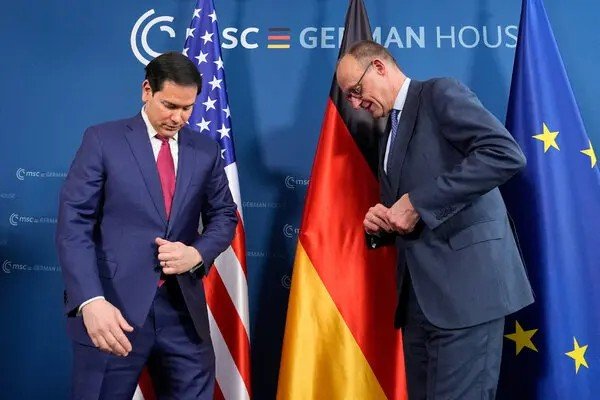
The 62nd edition of the three-day forum took place at a moment when transatlantic relations are being reassessed amid American demands for a profound reconfiguration. The war in Ukraine, debates over burden-sharing for European security, European strategic autonomy, and the global priorities of the United States placed the US–Europe relationship once again at the center of discussions. The speeches of U.S. Secretary Marco Rubio, German Chancellor Friedrich Merz, French President Emmanuel Macron, and British Prime Minister Keir Starmer reflected a “tension” between preserving transatlantic unity and increasing European strategic autonomy. The three days of discussions, despite the fact that Secretary Rubio maintained a more moderate tone compared to last year’s speech by Vice President JD Vance, highlighted two competing visions for the West: one based on power and the other on values and principles. Nevertheless, in his speech, Marco Rubio repeatedly emphasized the importance of cooperation and shared responsibility. “We do not seek to divide, but to revive an old friendship and renew the greatest civilization in human history,” Rubio stated, underscoring historical and cultural ties with Europe: “For us Americans, our home may be in the Western Hemisphere, but we will always be a child of Europe” (CBS News, 14/02/2026). In addition to messages of solidarity and cooperation, his speech also contained sharp criticism, particularly of what Rubio described as a “dangerous illusion,” namely the belief that the liberal order would transcend the traditional logic of sovereignty and national interests (PBS, 14/02/2026).
The recalibration of U.S. foreign policy, entirely legitimate in international relations, has been a subject of discussion since the end of the Cold War, but this issue has gained increased intensity following recent geopolitical changes. The debates at MSC-2026 are a clear reflection of these efforts to balance American foreign policy in the face of new global challenges. This redefinition of U.S. foreign policy was anticipated with remarkable precision as early as 2018 by John J. Mearsheimer in his renowned book The Great Delusion: Liberal Dreams and International Realities: “Great powers rarely pursue a fully liberal foreign policy. As long as two or more of them exist on the planet, they have no choice but to pay close attention to their position in the global balance of power and to act according to the dictates of realism” (Mearsheimer, 2018).
From a realist perspective, the United States, as the world’s greatest power, is facing aggressive multidimensional competition and is seeking a redistribution of resources in relation to priority regions. This approach of the American administration aligns with John J. Mearsheimer’s argument in The Tragedy of Great Power Politics (2001) that great powers, in an anarchic international system, act to maximize security and preserve relative primacy, fully in sync as well with the renowned theorist Hans Morgenthau (2006), according to whom national interest, defined in terms of power, is the fundamental and guiding principle of foreign policy. This reorientation was clearly reflected in the American stance during MSC-2026, where the demand for a review of diplomatic and military commitments was reaffirmed, particularly regarding whether they align with the new strategic objectives of the United States in an increasingly unpredictable international environment.
At MSC-2026, American discourse emphasized the necessity for Europe to assume greater responsibility for its own defense, including increasing military spending. This position reflects an approach in which alliances are no longer viewed solely in political or historical terms, but are evaluated through a formula of cost and strategic benefit. One such example is the debate over defense expenditures and burden-sharing within NATO, where the United States is calling for greater financial and operational engagement from European countries (Becker, 2019; Desmaele, 2024). Although Secretary of State Marco Rubio stressed the need for a united transatlantic alliance and affirmed that the United States remains committed and is not seeking the end of this alliance, still, between the lines, certain “tensions” emerged regarding how to preserve the transatlantic axis and how to strengthen Europe’s strategic capacities (BBC, 14/02/2026). These tensions and discussions bring back into focus a well-known dilemma in international relations theory: how to preserve national interest (realism) while promoting cooperation and institutions that foster multilateralism and collective stability (liberalism). In Theory of International Politics, Kenneth Waltz (1979) argues that states primarily act in accordance with national interest and their relative power, while liberals such as Robert Keohane and Joseph Nye, in Power and Interdependence (2012), emphasize that institutions, norms, and interdependence can mitigate competition and produce positive outcomes for collective security. These perspectives were undoubtedly at the centre of attention and debate at MSC-2026.
Europe’s Response to American Demands
In his opening speech at MSC-2026, German Chancellor Friedrich Merz, using diplomatic language, expressed his concerns about American demands, calling for a new strategic balance between Europe and the United States. He stated that the rules-based international order “no longer exists in the form we once knew it” and warned that “in an era of great power rivalry, even the United States will not be powerful enough to act alone. Being part of NATO is not only a competitive advantage for Europe, it is also a competitive advantage for the United States” (The Guardian, 13/02/2026). Merz’s position is linked to the idea that Europe must strengthen its own strategic capacities and be an equal partner, not a subordinate one, which nevertheless implies preserving the transatlantic axis in the face of contemporary global threats. French President Emmanuel Macron was in line with the German chancellor when he stated in his speech that “this is the right time for courage, this is the right time for a strong Europe, and Europe must learn to become a geopolitical power” (Reuters, 13/02/2026).
The positions of Merz and Macron reflect the core principles of the coexistence of realism and liberalism in international relations, where states strive to preserve their power while simultaneously seeking to maintain strategic alliances. From this perspective, the growing rivalry among global powers has generated a new European dynamic toward shaping a more independent strategic framework, in which the role of the United States remains essential. This approach is consistent with the ideas of Kenneth Waltz and the analyses of Stephen Walt on balancing power and safeguarding national interests in an anarchic international system (Waltz, 1979; Walt, 1987).
British Prime Minister Keir Starmer, during his intervention, also presented a vision that combines, on the one hand, loyalty to the transatlantic alliance and, on the other, the necessity for a stronger and more unified Europe (Reuters, 14/02/2026). Starmer’s position corresponds with the liberal view that cooperation should not be reduced to domination, but should function as a structure in which states enhance their capacities reciprocally in order to achieve common objectives (Keohane & Nye, 2012). By emphasizing the need for closer cooperation with the EU and for a “strong Europe,” Starmer seeks to preserve cohesion within the alliance by integrating European strategic autonomy within the North Atlantic alliance.
Implications and Perspectives
The discourse articulated by representatives of the United States, EU countries, and NATO regarding the war in Ukraine and strategic competition with China reflects a reconfiguration of global security priorities. From the perspective of realist thought, recent developments have brought the theory of power back as the central pillar of the international system. John J. Mearsheimer (2019), in Bound to Fail: The Rise and Fall of the Liberal International Order, treats the return of power politics as inevitable in a multipolar international system. According to him, “the goal of great powers is to gain power at the expense of their rivals, but if that is not possible, to ensure that the balance of power does not shift against them.” Discussions in Munich on strengthening military capabilities, reinforcing nuclear deterrence, and increasing defense spending reinforce this observation and are fully consistent with President Trump’s “America First” policy.
In the transatlantic context, Russian aggression in Ukraine has served as a catalyst for restructuring European security. According to Gideon Rachman (The Age of the Strongman, 2022), the conflict in Ukraine has brought the concept of conventional warfare back into discussions in European capitals, accelerating processes of politico-strategic coordination and increases in defense spending. In this sense, the strengthening of the European Union in the military dimension, through coordination and increased defense budgets, demonstrates a rational and necessary effort toward strategic autonomy to balance dependence on the United States. However, Daniel Fiott, in Strategic Autonomy: Towards “European Sovereignty” in Defence, argues that European strategic autonomy remains interdependent with NATO structures, yet still complementary for common objectives (Fiott, 2018).
There is no doubt that the world is changing rapidly, new threats are increasing, and conventional ones are re-emerging. For this reason, the affirmation of the alliance requires trust and a rational balance between the realist logic of power and the liberal institutional architecture that has long served as a steadfast pillar of the Euro-Atlantic order and a synonym of the free world. In the context of current geopolitical crises and strategic rivalry among great powers, preserving Western unity is also decisive for peace and security in the Western Balkans. From a theoretical perspective, the importance of Euro-Atlantic unity for the Western Balkans is explained by structural realism—balance of power and deterrence as protection against threats (Walt, 1987)—and by the liberal order, which reduces the likelihood of conflict through norms and integration into multilateral institutions (Ikenberry, 2020). In this framework, the Euro-Atlantic perspective remains the only alternative for Kosovo as a strategic orientation. US–EU unity creates transformative power in this process, consolidates institutions and democracy, and limits destabilizing influences from external actors, enabling the aspiration for integration into the EU and NATO to become a real and secure prospect.