

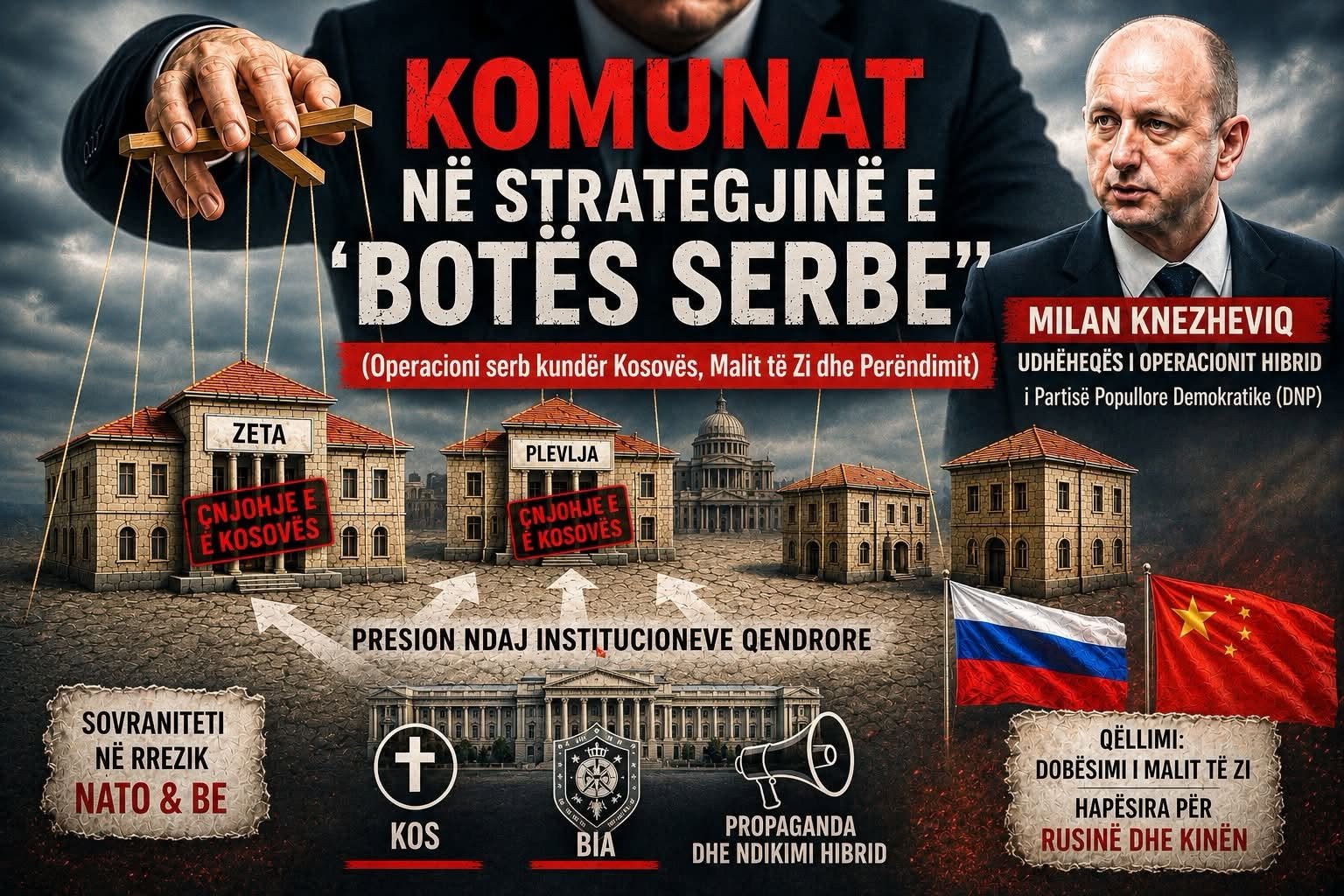
Although the recognition of a state falls within the exclusive competence of central government institutions, and the declarations adopted by the municipalities of Zeta and, more recently, Pljevlja on the “withdrawal of recognition” of Kosovo have no legal effect, Serbia continues to use municipalities where it enjoys political influence in Montenegro as part of its broader “Serbian World” project.
The coordinator of this operation, Milan Knezevic of the Democratic People’s Party (DNP), has made it clear that the objective is to influence as many municipalities as possible so that these local declarations can eventually be transformed into a binding resolution in the Montenegrin Parliament (RTS).
The strategic objectives of this initiative cannot be fully understood without considering the attempt on 4 June to undermine the Tivat Summit through the deployment of 87 expelled “mercenaries” allegedly linked to President Aleksandar Vucic.
Within the framework of this operation, the call for the “withdrawal of recognition” of Kosovo appears to function primarily as a mobilizing issue, exploiting the symbolic narratives of “betrayal,” “shame,” and “injustice.” By contrast, weakening Montenegro’s Euro-Atlantic orientation would represent a far more significant strategic victory for the “Serbian World” project.
Knezevic’s appeals for younger politicians to “correct the shame” inflicted upon Serbia do not refer to Montenegro’s state interest, but rather to the Serbian national interest. This reflects the very essence of the “Serbian World” doctrine: Serbs living in neighboring states are regarded as instruments of a shared political space centered on Belgrade.
The Dangerous Absurdity
The pattern being pursued is characteristic of hybrid influence strategies: first, create “facts on the ground” where resistance is weakest, and then present them as expressions of the popular will in order to exert pressure on central state institutions. It does not matter that municipal declarations have no legal effect; what matters is their propaganda value.
Ultimately, these manufactured “facts” against Kosovo’s recognition are transformed into political pressure on Montenegro’s central authorities, undermining the country’s cohesion as a NATO member and as the European Union’s most advanced accession candidate.
Statements claiming that Kosovo “is not recognized within the territory of the municipality,” although legally absurd, convey a far more dangerous message: that Montenegro lacks sovereignty and has no authority over its own foreign policy. Regardless of their legal invalidity, such declarations are designed to normalize the notion that decisions taken by the state institutions in Podgorica can be overturned by municipalities.
When this is combined with hybrid interference carried out through the Serbian Orthodox Church and Serbia’s Security Intelligence Agency (BIA), it becomes evident that weakening Montenegro’s Euro-Atlantic institutions is viewed as a prerequisite for advancing the expansionist ambitions of the “Serbian World” project and for creating greater space for Russian and Chinese influence in the Western Balkans.
For this reason, the rhetoric and political initiatives promoted by Milan Knezevic are directed not only against Kosovo but also against Montenegro’s state sovereignty. Kosovo’s recognition is portrayed as a “shame” and an “injustice” allegedly inflicted by Montenegro upon Serbia, deliberately invoking historical grievances and emotionally charged symbolic narratives to mobilize support for a broader geopolitical agenda.
Symbolic “Hybridization”
Montenegro’s sovereign foreign policy decisions have been systematically framed within Serbia’s strategic communication as acts of “betrayal” that must be reversed. Its accession to NATO, its path toward European Union membership, its recognition of Kosovo, and its sanctions against Russia are all woven into a single narrative of “correction”: Montenegro must return to political subordination under Belgrade.
Within this strategy, Serbia’s public broadcaster RTS portrays Kosovo as an inseparable component of the cultural identity of part of Montenegro’s population. Through references to Petar II Petrovic-Njegos, the Kosovo Covenant (Kosovo Myth), the Serbian language, and the Serbian Orthodox Church, RTS strategically constructs a narrative of a threatened Serbian identity, claiming that it remains under attack as long as Montenegro continues to recognize Kosovo.
By blending foreign policy with questions of identity, religion, and political loyalty, RTS and other media aligned with President Aleksandar Vucic promote polarizing communication, disinformation, and nationalist mobilization as instruments of the “Serbian World” strategy. For this reason, municipal declarations should not be dismissed merely because they have no legal effect on Montenegro’s recognition of Kosovo.
If these initiatives deepen social divisions, consolidate the pro-Serbian electorate, and increase political pressure on Montenegro’s central government, they may strengthen Belgrade’s influence while simultaneously undermining the country’s European integration and challenging its Euro-Atlantic orientation.
Within this broader strategic framework, Kosovo remains the permanent battlefield—not because of its legal status, but because the Kosovo myth continues to serve as one of the most powerful instruments for political mobilization and geopolitical influence in the Serbian World project.