

Gjon Culaj, Associate Fellow at the “Octopus” Institute
Coercive diplomacy is a concept that was developed primarily after the Cold War within the fields of strategic studies and international relations. Unlike the direct use of military force, it seeks to achieve political objectives by combining diplomatic negotiations with a credible threat of the use of force (George, 1994:2-3). In his book The Limits of Coercive Diplomacy, Alexander L. George defines coercive diplomacy as a strategy that attempts to persuade an opponent to stop a certain action, withdraw from an existing policy, or accept a specific agreement (George, 1994:10). Thomas Schelling (1966), in his work Arms and Influence, emphasizes the distinction between coercion through the use of force and coercion through the threat of force. According to him, power in international relations does not rest solely on the ability to harm an opponent, but rather on the ability to convince the opponent, through negotiation, that an alternative course of action is more rational than continuing resistance (Schelling, 1966:3). In this sense, coercive diplomacy represents an intermediate approach between traditional diplomacy and the direct use of force. It does not necessarily seek military intervention under all circumstances, nor does it rely exclusively on the willingness of the parties to reach a solution. Instead, by combining dialogue with pressure and a credible threat, this approach aims to influence the perceptions and strategic calculations of the parties involved in a conflict, encouraging them to alter their positions or accept an agreement.
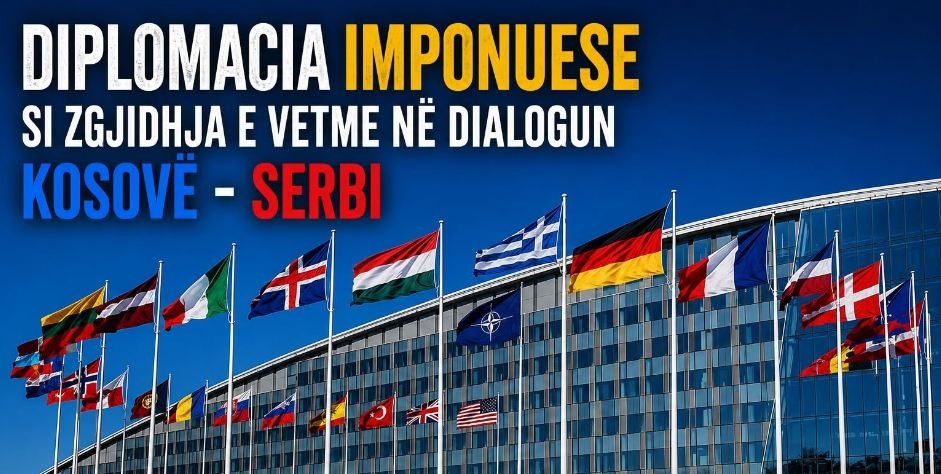
The Kosovo – Serbia dialogue continues to remain one of the most complex challenges for regional security and European diplomacy. For nearly two decades, international actors have undertaken numerous diplomatic initiatives aimed at normalizing relations between the two parties. However, despite the mediation efforts of the European Union, the dialogue process has achieved limited progress, resulting in several technical agreements but remaining far from reaching a final peace agreement that would comprehensively address the main political and security issues between the two states. Against this backdrop, an important question arises: can traditional diplomacy, grounded primarily in negotiation, dialogue, and compromise, achieve normalization while Serbia continues to pursue a hybrid strategy challenging Kosovo’s political status, sovereignty, and territorial integrity? Under these circumstances, coercive diplomacy appears to represent the only viable and effective alternative. The history of conflicts in the former Yugoslavia provides clear evidence that the intervention of Western powers, led by the United States, through diplomatic pressure and military interventions, has imposed political agreements and contributed to the end of armed conflicts.
The Role of Coercive Diplomacy in Ending Conflicts in the Former Yugoslavia
The violent dissolution of Yugoslavia between 1991 and 1999 is considered one of the greatest security challenges faced by Europe after the end of the Cold War. The wars in Croatia, Bosnia and Herzegovina, and Kosovo exposed the limitations of traditional diplomacy in managing ethnic and territorial conflicts. Steven L. Burg and Paul Shoup (1999), in their book The War in Bosnia-Herzegovina: Ethnic Conflict and International Intervention, argue that the initial efforts of the European Union and later the United Nations to mediate ceasefires and political agreements were largely unsuccessful due to the absence of effective mechanisms for their implementation (Burg & Shoup, 1999:171–205).
Furthermore, the lack of political unity among international powers and the reluctance to undertake more decisive military or diplomatic measures contributed to the prolongation of conflicts and the deterioration of the humanitarian crisis. This period highlighted the need for a more active role and greater involvement of NATO in maintaining peace and regional security. The analyses of Susan L. Woodward further reinforce the argument that the repeated failures of the international community cannot be explained solely by the political, ethnic, and historical complexity of the conflicts in former Yugoslavia, but also by the lack of political will and the absence of a coordinated and effective strategy by international organizations and major powers to manage the dissolution of Yugoslavia (Woodward, 1995:367–385).
Faced with this deadlock and the war crimes occurring on the ground, the United States and NATO gradually shifted from an approach based primarily on negotiations toward a hard power strategy that combined diplomacy with political-military pressure and economic sanctions. This approach corresponded with the concept of coercive diplomacy, according to which a credible threat of the use of force, combined with a diplomatic offer, can compel an opponent to change its behavior (George, 1994:2-3). However, these measures failed to prevent ethnic cleansing and war crimes (United Nations, 1999:71-75) . Following the Srebrenica massacre in July 1995 and the Markale marketplace attack in Sarajevo, NATO launched Operation Deliberate Force, an air campaign against Bosnian Serb military targets. The air strikes, combined with ground offensives by Bosnian and Croatian forces and American diplomatic pressure, created the conditions for the parties to accept negotiations in Dayton.
The case of Kosovo during 1998 – 1999 also represents one of the most significant examples of the use of coercive diplomacy in the post-Cold War period. The Rambouillet Conference (February – March 1999) was the culmination of diplomatic efforts and served as the main instrument of coercive diplomacy. Once again, the United States played the leading role in the Rambouillet process. The Clinton administration viewed the Kosovo crisis as a test of the credibility of Western policy after the failures in Bosnia, where delays in intervention had resulted in severe humanitarian consequences. The American strategy was based on the assumption that negotiations without pressure would not be sufficient to alter Belgrade’s behavior (Los Angeles Times, 14/02/1999). For this reason, diplomatic efforts and NATO’s military preparations progressed simultaneously, reinforcing each other as part of a broader strategy of coercive diplomacy. In this context, Rambouillet was not merely a peace conference, but also an instrument for applying pressure on the Milosevic regime with a clear message that rejecting an agreement would result in direct military consequences. The outcome is well known: on 24 March 1999, NATO launched Operation Allied Force, an air campaign that ultimately led to the liberation of Kosovo and the establishment of an international civil and military presence in the territory.
From the “Failure“ of the EU-Mediated Kosovo – Serbia Dialogue to the Imperative of U.S. Engagement through Coercive Diplomacy
Since the beginning of the European Union-mediated dialogue in 2011, expectations were that the process would become the primary mechanism for the normalization of relations between Kosovo and Serbia and for the consolidation of peace and stability in the Western Balkans. However, after nearly two decades of negotiations, the dialogue has produced several agreements but very limited concrete results on the ground. This demonstrates the limitations of European diplomacy as a mediator and, at the same time, reveals Serbia’s strategy of using the dialogue not as an instrument for genuine normalization, but rather as a mechanism to preserve the status quo and prevent the consolidation of Kosovo’s international subjectivity.
Why is renewed American engagement necessary in this process? U.S. involvement should not necessarily be understood as a replacement for the European Union, but rather as a complementary element that would provide the process with greater strategic weight and stronger mechanisms for implementation. The United States possesses several advantages that make it a unique actor in the Kosovo issue. Unlike diplomacy based solely on negotiations, the United States has significant capabilities to connect diplomacy with concrete political, economic, and security instruments. Washington’s role within NATO, its presence through KFOR, and its influence over the European security architecture provide it with a level of capacity and leverage that other actors, particularly the European Union, do not possess.
Kosovo’s history demonstrates that the United States has been the key actor during moments when genuine political change was required. In 1999, it was the combination of American diplomatic pressure, NATO’s military threat, and international intervention that created the conditions for ending the war (Barthe & David, 2007:88-90). The “failure” of the EU-mediated Kosovo – Serbia dialogue does not indicate that diplomacy has failed as a concept, but rather that the current model of EU diplomacy lacks the necessary instruments to guarantee effective implementation. The case of Kosovo in 1999 demonstrates that historical transformations in the Balkans have been achieved only when diplomacy has been supported by credible political commitment and military power. For this and many other reasons, Kosovo should seek a more active and direct engagement of the United States in the dialogue process with Serbia, particularly at a stage when continuous diplomatic efforts of EU have failed to produce a final and sustainable agreement.
A comprehensive Kosovo – Serbia agreement requires a guarantor that possesses not only the willingness to mediate but also the political, diplomatic, and security capacities to ensure its implementation. In the current geopolitical environment, and considering the role the United States has played in Kosovo’s state-building processes, a more direct American involvement through coercive diplomacy should be considered crucial for establishing the necessary conditions required to achieve a sustainable and enforceable peace agreement between Kosovo and Serbia.