

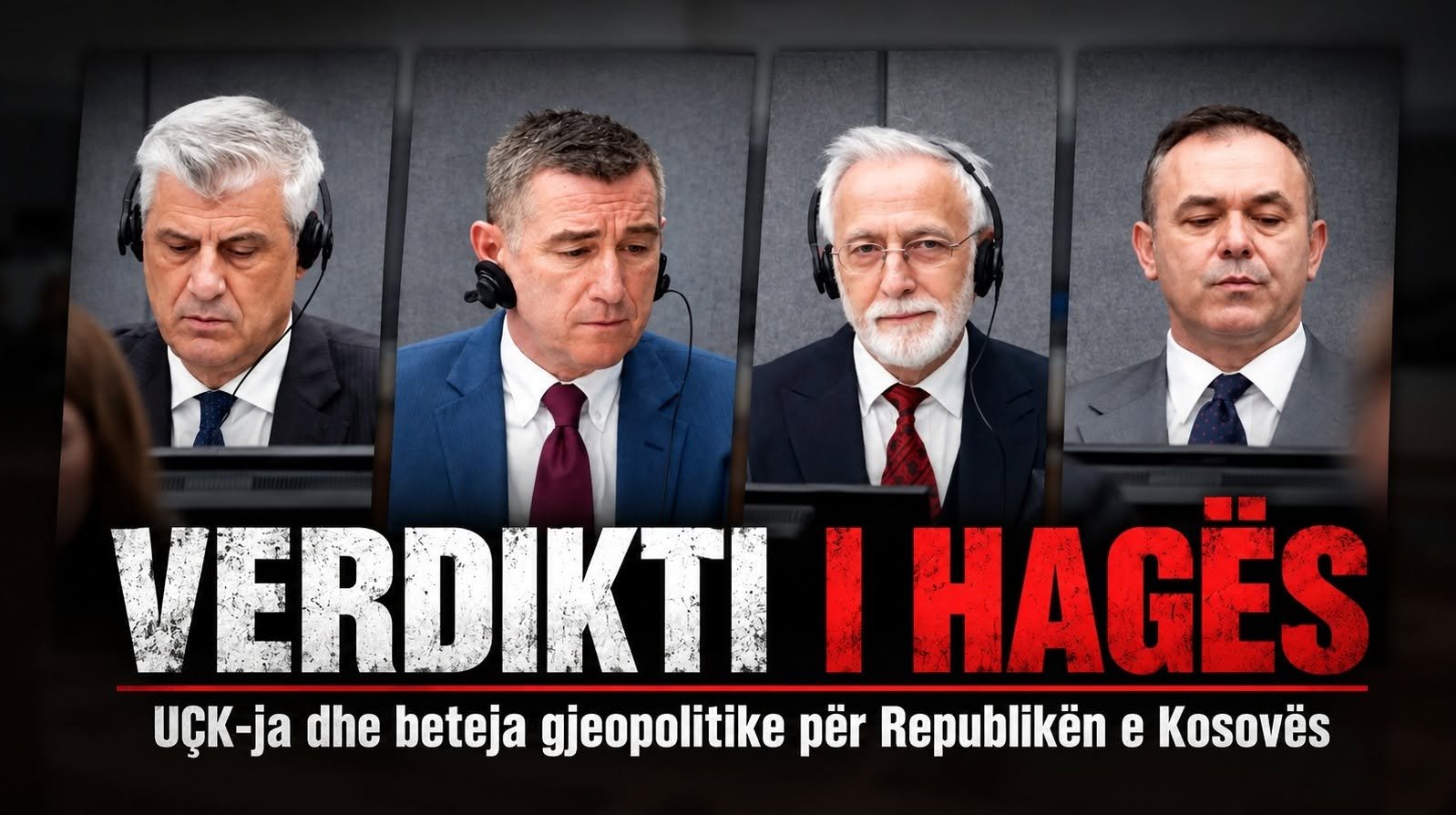
(The KLA and the Geopolitical Battle for the Republic of Kosovo)
On 16 September 2026, the Specialist Chambers in The Hague will deliver the judgment against four leaders of the Kosovo Liberation Army: Hashim Thaçi, Kadri Veseli, Rexhep Selimi, and Jakup Krasniqi. Nearly six years of detention and more than three years of trial proceedings are not only individual injustices against the accused, but also a protracted legal battle over the truth about Kosovo. Formally, the Court will not rule on the justness of the KLA’s war (KSC-OFFICIAL, 03.04.2023) or the legitimacy of NATO’s intervention (1999), but the Prosecution’s theory has made an individual outcome to this process impossible. The core of the indictment, with its allegation of a Joint Criminal Enterprise (JCE), makes 16 September a historic moment in the narrative battle over the truth of the liberation war (KSC-BC-2020-06). Against this backdrop, protests and public demonstrations in support of the accused have been organised in Prishtina, Skopje, Tirana, and across the diaspora, driven by the conviction in their innocence, reinforced particularly by the testimony of former senior Western officials.
I. JCE vs. the Truth
In an armed conflict, particularly in the circumstances of the KLA’s guerrilla organisation, crimes may occur, but not necessarily as part of a Joint Criminal Enterprise. Individuals may commit criminal acts without being part of a centralised policy. Formal structures may exist without real control, just as leaders may lack effective authority on the ground. This is the line on which the Defence has built its challenge to the Specialist Prosecutor’s indictment. Thus, responsibility for a crime and the existence of a Joint Criminal Enterprise are not the same thing. The issue in the case of Thaçi, Veseli, Krasniqi, and Selimi is not whether crimes were committed, but whether the SPO has succeeded in proving their connection to the common criminal purpose and the participation of the accused in its implementation. This distinction is decisive for the proceedings.
Positions within an organisation do not automatically imply effective control or knowledge of every action on the ground. Therefore, potential crimes cannot, without evidence, be transformed into a criminal policy of the entire organisation. In this regard, beyond what has and has not been seen during the proceedings in The Hague, the testimonies of James Rubin – adviser to Secretary Albright and State Department spokesperson during the war; Paul Williams – adviser to the Kosovo delegation at Rambouillet; Wesley Clark – NATO’s Supreme Allied Commander Europe; John Duncan and Michael Durkee – his advisers; Christopher Hill – U.S. Special Representative for Kosovo during the war; and James Covey – Deputy Head of the UNMIK mission, appear decisive.
As key figures who knew the KLA, negotiated with its leaders and commanders, and had access to military and intelligence information, their testimony cannot be disregarded in relation to the SPO’s allegation. Their testimonies, according to which the KLA was a fragmented organisation, with zone commanders and without a clear hierarchy, make it almost impossible to substantiate the existence of a centralised criminal project (Koha, 03.01.2026).
The burden of proof has rested with the Prosecution; however, according to the lawyers, the evidence that would establish the connection between the crimes and the common criminal purpose of the four KLA leaders has been lacking (Justiceinfo.org, 20.02.2026). Meanwhile, the allegation of a violent campaign against political opponents, Serbs, and Roma, aimed at seizing power and establishing complete control through terror, is not only denigrating to the objectives of the liberation war, but is also contradicted by post-war developments, particularly by their political role during the Vienna process.
Despite this, in its closing statements, the SPO insisted that the accused be found guilty and sentenced to 45 years’ imprisonment each, while the Defence teams sought a full acquittal for each of them (KSC & SPO, 9, 13, 16, 18 February 2026). Thus, the parties remained in their respective positions, with the final verdict now in the hands of the Trial Panel.
Convinced of their innocence and expecting justice, thousands of citizens in Prishtina have taken part in the “March for Freedom”, while, given the historic significance of the decision, international actors have appealed for calm and security institutions have taken measures to manage the situation. On 16 September, the legal battle over the truth of the KLA comes to an end, but the geopolitical battle seeking to distort that truth does not.
II. The Verdict in the Geopolitical Battle
Alongside intensive efforts to manipulate the most significant legal process concerning Kosovo, Serbia and Russia have prepared to exploit every possible scenario in pursuit of their revisionist strategy. The narrative battle over the “criminal KLA” and NATO’s “aggression” in 1999 will continue through the rhetoric of an “unjust West with double standards,” intensifying the narrative of “victimhood” through claims of a “Kosovo that represses Serbs” in the event of an acquittal, whereas in the opposite scenario, everything would be interpreted as confirmation of their theses, with the aim of rewriting history. For this reason, in recent years they have intensified the strategy of denying genocide and war crimes in Croatia, Bosnia and Herzegovina, and Kosovo, while calculating on the rehabilitation of Milošević’s project.
Vučić’s shifting statements also serve this purpose. He initially “announced” that the verdict would be “largely an acquittal for Thaçi,” referring to information from his intelligence services (RTS, 28.08.2026); he later raised the alarm with an alleged “warning of violence,” threatening that “after 16 September, we will explain what people from the international community have done against Serbia over the past five to six years” (RTS, 03.09.2026); and finally claimed that he had “learned” from international sources in Paris that “Thaçi would receive a severe sentence” (RTS, 12.09.2026).
The first serves to prepare an attack on international justice as “one-sided,” by refusing to accept an acquittal, while the second serves to generalise a potential conviction into a judgment against the KLA, presenting it as confirmation from The Hague of their “truth” about the “persecution and terror” of Serbs. The KLA’s “criminal leadership” would then be framed as a “criminal war,” in order to “prove” that NATO’s intervention was “unjust”.
This is the geopolitical risk posed by a conviction or a “balanced” verdict (two acquitted and two convicted), as has been discussed for some time in Prishtina, which threatens the Euro-Atlantic architecture of the Western Balkans. Conversely, the opposite outcome would affirm the justness of the struggle for freedom and ultimately demolish the hybrid strategy of historical revisionism that serves as the political foundation for the “Serbian World”.
In this context, the framing of Serbian propaganda around the “growing pressure on the Court and the international community” should also be considered, referring to statements made in Prishtina, warnings by Serbian officials of “possible violence” (Euronews.rs, 15.09.2026), as well as the intensification of inflammatory and polarising content by fake accounts in the online sphere.
III. Mladić and the Test for the West
If, following the ICJ ruling (ICJ, 22.07.2010), challenging Kosovo had become more difficult, the strategy had to intensify the fabrication of criminal allegations. Dick Marty’s report on “organ trafficking” achieved its objective: the Council of Europe called for an investigation into the KLA, while Kosovo was compelled to establish a special court. The Yellow House and organ trafficking allegations collapsed, but Serbia continued to feed the case file against the KLA leaders (Milovan Drecun: RTS, 20.07.2018).
Their potential conviction would be used as evidence for the “criminalisation” of the KLA, while the liberation war, together with NATO’s intervention, would effectively receive a “guilty verdict” from international justice. Such an outcome would legitimise the ‘state honouring’ of the chief criminal of “selective justice”, culminating in the “right” of the Serbian people to defend themselves against “historical injustice”.
Mladić’s funeral ceremony in Belgrade was evidence of the hybrid continuity of Milošević’s project. As an instrument of that project, who died while serving a life sentence for genocide, crimes against humanity, and the taking of UN personnel as hostages (ICTY, 22.11.2017), he was buried in Belgrade with the highest state and church honours, reviving the “blessed” politics of violence, terror, and ethnic cleansing for a Greater Serbia.
The government aircraft carrying his body from The Hague, the commemoration at the Army House, the liturgy and funeral service conducted by Patriarch Porfirije, the military carrying of the coffin, the gun salutes, the ministers, Milorad Dodik, Russian Ambassador Bocan-Kharchenko, and the tributes paid by thousands of citizens organised from Serbia, Republika Srpska, and Montenegro (RFE/RL, 08.09.2026) are evidence confirming the Political Manifesto of the “Serbian World”, reopening the wounds of the victims and ‘shocking’ the international community (Reuters, 08.09.2026).
However, despite the strong reactions from Brussels, Serbia not only failed the “European test”, but has turned its own test into a “test for the EU”: glorifying Mladić in order to rehabilitate Milošević’s policy, while deepening its alignment with Russia and seeking to undermine the Republic of Kosovo as the trophy of the Western architecture in the Balkans.