

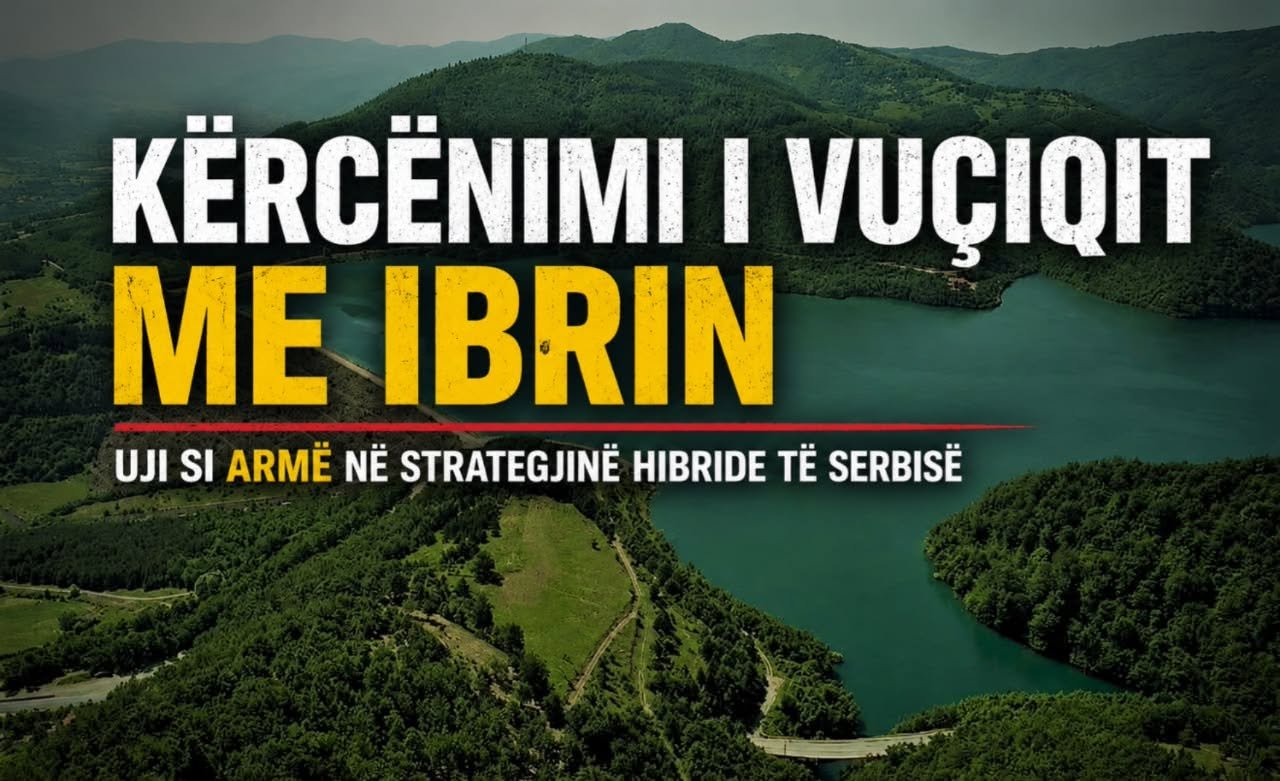
A statement containing fascistic elements that constitutes yet another direct threat against Kosovo. Vucic revealed his plan for the “protection of Serbs,” using water as an instrument of pressure: “We will change the course of the Ibar River, and then we will see what the Albanians will do” (RT Balkan, 9 August 2026).
Linking this “plan” to claims about the “mistreatment” of Serbs is not merely rhetoric intended for domestic consumption, but a further escalation of Serbia’s hybrid strategy against Kosovo—one that indirectly corroborates responsibility for the sabotage of the Ibër-Lepenc Canal in 2024.
Following the failure of the attack, which was designed to cause destabilization due to its potential consequences for water supplies (municipalities in northern Kosovo, Mitrovica, Vushtrri, Prishtina, Drenas, Fushë Kosovë, and Obiliq) and energy supplies (the thermal power plants in Obiliq), Vucic is demonstrating that Serbia has not abandoned the use of natural resources as part of its arsenal against Kosovo.
Water as a “Weapon”
Beyond the constraints imposed by international law, which do not permit such an action (UNECE Convention on the Protection and Use of Transboundary Watercourses and International Lakes, 1992), the impact it would have on Serbian citizens in northern Kosovo, and the U.S. assessment that treats Ujmani/Gazivode as an issue of regional security (Pacific Northwest National Laboratory, Water Resource Opportunities at Lake Gazivode/Ujmani, 14 April 2021), the presidential threat and its linkage to the fabricated narrative of the “mistreatment” of Serbs reflect the advancement of the “victimization” narrative into a phase of coercive pressure in pursuit of the “Serbian World.”
Vucic’s shift in position from “the idea exists, but I am against it” (Danas, 1 December 2024) to “we are gathering engineers to see how we can do it” (RT Balkan, 9 August 2026) demonstrates the transformation of Serbia’s strategic communication, consistent with Minister Paunović’s statements, the “heroization” of war criminals, and the arrest of a Serb suspected of having provided information related to mass graves.
The idea of diverting the course of the Ibar River, which “would leave Ujmani/Gazivode without water,” had circulated in Serbia before. According to expert Ljubisa Mijacic, “Serbia has the technical capacity to divert it,” and this represents a “real threat” (Kosovo Online, 22 November 2025). By contrast, Spanish geography professor Miguel Borja Bernabe-Crespo dismisses the risk, emphasizing the obligations arising from the international legal regime governing transboundary waters (Radio Free Europe, 5 December 2024).
Nevertheless, the calculated impact of the threat, in the context of Kosovo’s “dependence” on this water system, helps explain its retaliatory framing directed at Albanians as an element of a broader strategy to portray the conflict in ethnic terms. In this context, the “protection of Serbs” becomes the premise through which the threat is intended to be legitimized.
The Advanced Threat
The strategy of “victimization,” aimed at demonizing Kosovo by portraying it as “repressive” and blaming the West as “co-responsible,” is preparing the ground for an advanced phase centered on “Serbia’s right to respond.” The radicalization of chauvinistic discourse following Minister Paunovic’s statements, Dacic’s support for her, and the “heroization” of war criminals and individuals arrested in connection with the Recak Massacre makes the threat concerning the Ibar an extension of Vucic’s message at the commemoration of Operation “Storm”: that “Serbia is strong enough to protect the Serbs” (Insajder, 4 August 2026).
The effort to normalize the language of violence, ethnic cleansing and, ultimately, the “punishment” of Albanians not only factors in the continued “tolerance” of Serbia’s “two-chair” balancing policy and Vucic’s potential domestic political gains, but also seeks to legitimize the “Serbian World” as a repackaged form of Milosevic’s project.
This is Serbia’s hybrid strategy in its advanced form. Military intervention is not necessary as long as destabilizing objectives can be pursued through water, energy, sabotage, espionage, and disinformation. From this perspective, the threat concerning the Ibar constitutes a strategic lever, while Ujmani/Gazivode represents a national security vulnerability.