

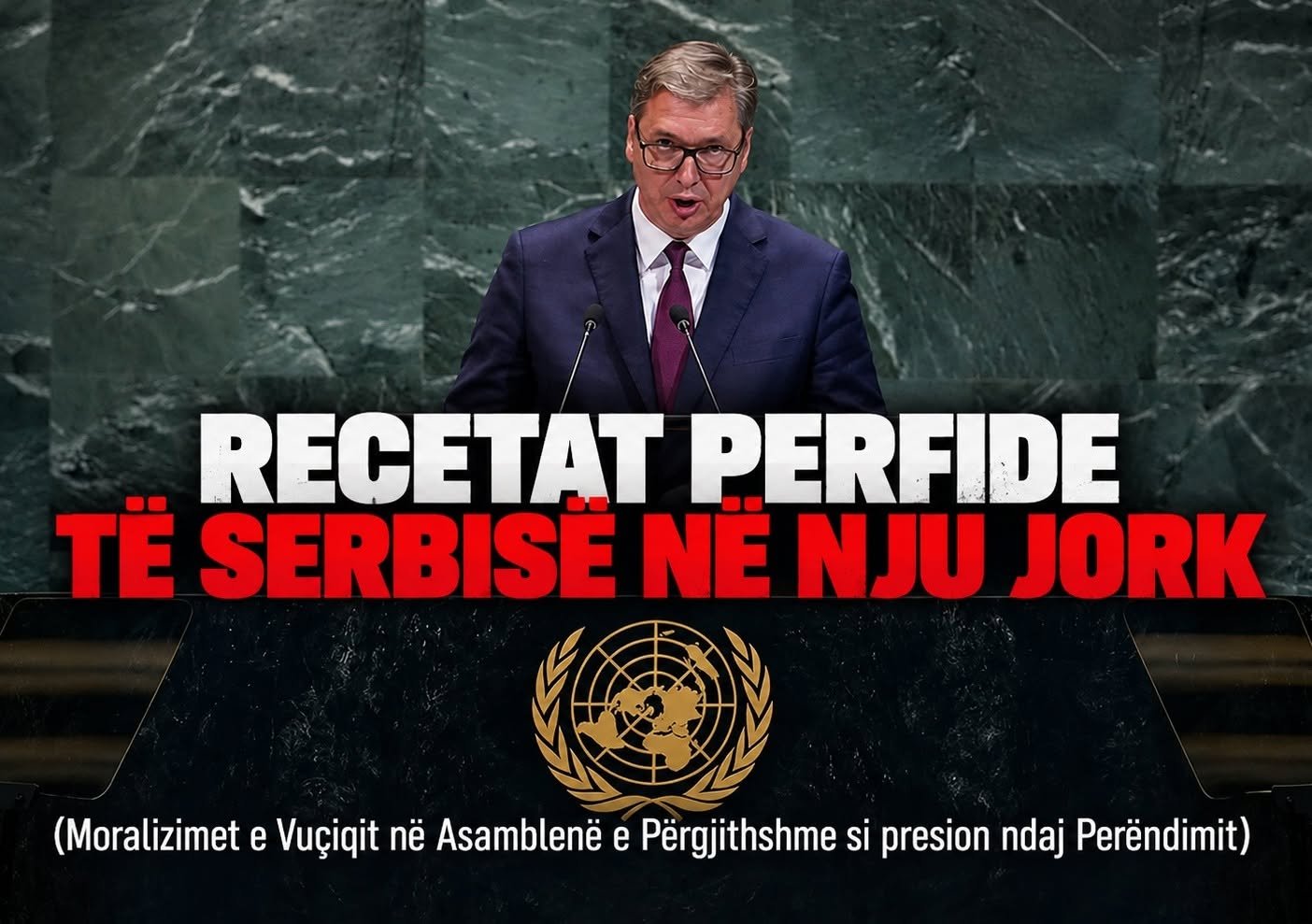
Once upon a time, there was a cunning minister who had crafted the packaging for his boss’s campaign of terror. Thirty years later, at the heart of world diplomacy, he tried to put those who stopped the terror, ethnic cleansing and genocide in Croatia, Bosnia and Herzegovina, and Kosovo in the dock.
Will the West let Vučić’s account of a world in turmoil—and his choice of who is to blame for setting it ablaze—go unchallenged?
Putin’s “European” Spokesman
It does not matter, in this telling, that Croats, Bosniaks and Albanians were killed, slaughtered and raped: stopping Serbia was the West’s “sin” that supposedly undermined the international order. That was the message beneath Aleksandar Vučić’s “lesson” to small countries about the “deception” of great powers at the UN General Assembly (predsednik.rs, 23 September 2026). Kosovo was not the only subject he drew into his account of Serbia as a victim in the 1990s and of NATO’s 1999 bombing.
He also accused Croatia of a “revival of Nazism” and of taking “pride in its Nazi past”. Croatian Prime Minister Andrej Plenković responded swiftly, pointing to the glorification of Ratko Mladić and the state funeral held for him. “It is a smear campaign that not even he himself believes, let alone the international community. Every such statement takes Serbia another step away from the values of the European Union and EU membership,” Plenković said (HRT, 24 September 2026).
At Kaja Kallas’s lunch with Western Balkan leaders, Prime Minister Albin Kurti, without naming Serbia directly, said that “Kosovo must not and cannot remain hostage to a state that protects and rewards this century’s criminals, glorifies those of the late twentieth century, denies and conceals crimes, refuses to cooperate in clarifying the fate of those forcibly disappeared, and continues the administrative ethnic cleansing of Albanians in the Preševo Valley” (Office of the Prime Minister of Kosovo, 24 September 2026).
Vučić avoided the truth about the crimes against humanity, genocide, rape and ethnic cleansing committed during the wars in the former Yugoslavia—crimes addressed by the UN’s own tribunal, the ICTY, in its indictment and proceedings against Milošević (Prosecutor v. Slobodan Milošević et al., Case No. IT-99-37-PT) and in final judgments against many of his political, military and institutional subordinates (Šainović et al., Appeal Judgment, 23 January 2014; Final Decision concerning Ojdanić, 31 January 2013). Instead, he used the UN General Assembly to outline the “Serbian World” project through claims of Serbian victimhood and NATO’s supposed “injustice” in 1999. He claimed that Serbia had fulfilled all its obligations under the Brussels Agreement, overlooking its grave breach of that agreement through the attack in Banjska (EEAS, 24 September 2023). At the General Assembly, he again acted against its spirit by thanking the states that have not recognised Kosovo (Agreement on the Path to Normalisation between Kosovo and Serbia).
Playing the role of Putin’s “European spokesman”, and invoking “neutrality” to make that role sound more credible, Vučić told Western countries that they had lost the moral standing to defend Ukraine’s territorial integrity because they had taken part in an effort to strip Serbia of “14 per cent” of its territory.
Flattery in the Service of the “Serbian World”
According to Vučić, NATO’s bombing and the recognition of Kosovo’s independence opened “Pandora’s box”, violated the UN Charter and set the precedent that is now destroying the international order. Immediately after discussing Kosovo, he widened his map of regional “threats”, accusing Croatia of a “revival of Nazism” and of taking “pride in its Nazi past”. He invoked Jasenovac to frame Serbs as victims during the Second World War.
By shifting between historical periods to support his broader narrative of Serbia’s supposed “right”, he played the card of two Americas: he labelled the Clinton administration “destructive” while presenting the Trump administration as a hope for a “fairer order” that would favour Serbia. His reversal of the narrative, which casts Serbia as a “moral authority” in today’s troubled world, rests on long-standing themes aligned with Russia’s positions (NATO aggression, Western double standards). At the same time, he claims “neutrality” in the current geopolitical conflict, which he links to the “injustice” of 1999.
The historic alliance with America, Ustaše crimes against Serbs and the “sin” committed over Kosovo are the selective links Vučić uses to portray Serbia as a perpetual victim. He skips over the Milošević era and Serbia’s responsibility for the repression, crimes, massacres and genocide that prompted the international response.
He does not tell the General Assembly why Ratko Mladić was given a funeral with state honours, despite the sharp reaction from the EU that Serbia says it wants to join. Nor does he explain why he continues to protect Radoičić, despite repeated calls from the US, EU and NATO for him to face prosecution after the attack in Banjska.
He cannot answer those questions while avoiding Milošević. And he avoids Milošević because he has not distanced himself from the aims of the “Greater Serbia” policy. He said as much himself in 2018 (predsednik.rs, 11 September 2018), and in 2026 he kept Minister Paunović in office after her statements rehabilitating Milošević.
In this context, the honours accorded to Mladić help explain the strategic evolution of a project now disguised as the “Serbian World” and adapted to today’s geopolitical rivalry. This is the framework through which Vučić’s speech should be understood: as “moral” pressure on the West, a justification for Putin and an attempt to legitimise Serbia’s chauvinist ambitions.
Revisionist “Pressure” on the West
Facts do not matter; what matters is how they are interpreted, as the twentieth-century American philosopher George Herbert Mead might suggest (Symbolic Interactionism of George Herbert Mead, in E. M. Griffin, A First Look at Communication Theory, 8th ed., New York, 2012). Facts do not speak for themselves. Reframing them to serve Serbia’s narrative is what Vučić is attempting to do.
Banking on the possibilities offered by the digital revolution and the features of the “post-truth” era, he appears to assume that ICTY records (Prosecutor v. Ratko Mladić, Appeal Judgment, Case No. MICT-13-56-A; Prosecutor v. Vlastimir Đorđević, Case No. IT-05-87/1-A) and contemporary reports by international organisations such as Human Rights Watch (Humanitarian Law Violations in Kosovo, 1 October 1998; A Week of Terror in Drenica, 1999; Under Orders: War Crimes in Kosovo, 2001) and Amnesty International (A Decade of Unheeded Warnings, 1999) will remain “silent” in drawers and archives, or be overlooked by new generations of political leaders.
That is why the best way to dismantle Vučić’s “narrative trap”, designed for maximum effect amid today’s concerns about international conflict, is to keep communicating the facts as established by the courts and documented by the media.
International law cannot be invoked to frame NATO’s bombing as “aggression” while disregarding hundreds of massacres and what the UN tribunal established about the operation to conceal crimes through mass graves in Batajnica, Petrovo Selo (ICTY, Đorđević judgment, 2011) and Rudnica, among other places. Identification of remains found in Kalludra and Jabuka in Zubin Potok is also ongoing in most cases (Radio Free Europe/Radio Liberty, 19 September 2026).
Nor can international law be used to cast Kosovo’s independence as a Western “sin” while ignoring the terror, systematic repression and genocide, as well as the conclusion reached by the UN’s own court concerning the declaration of independence (ICJ, 22 July 2010).
And “neutrality” cannot be used to portray Serbia as an “ally of America” while it continues its strategic alignment with Russia and China on militarisation and revisionist aims (RFE/RL, 7 January 2026; European Commission, Serbia 2025 Report). Serbia glorifies Mladić and protects Radoičić, defying calls from the United States and NATO and rebukes from the EU (Reporteri, 24 September 2026). It also undermines US interests identified in the national emergency concerning the Western Balkans (The American Presidency Project, 22 June 2026).
Vučić’s attempt to obscure the truth—casting President Clinton as a “destroyer” of the international order, Serbia as an “ally of America”, flattering President Trump and invoking Croatian “Nazism”—does more than advance the “Serbian World” project. It also seeks to legitimise Russia’s aggression against Ukraine, carrying an implicit moralising message that Western “injustice” somehow “forced” Putin’s hand.