

Author: Gjon Culaj, External Associate at the “Octopus” Institute
Kosovo Specialist Chambers judgment in The Hague against Hashim Thaçi, Kadri Veseli, Rexhep Selimi and Jakup Krasniqi, delivered on 16 September 2026, found all four defendants guilty of the war crimes (arbitrary detention or arrest, cruel treatment, torture and murder), and sentenced Thaçi and Krasniqi to 25 years in prison, Veseli to 18 years and Selimi to 13 years. The Trial Panel acquitted all four defendants of crimes against humanity charges (Koha.net, 16/09/2026). Soon after the verdict was announced, its political and media appropriation began in Belgrade, quickly shifting the verdict into a much broader political discourse. Serbian authorities and pro-government media presented it exclusively as “confirmation of their interpretation of the KLA and the Kosovo war.”
The Judgment as “Evidence” Against Kosovo
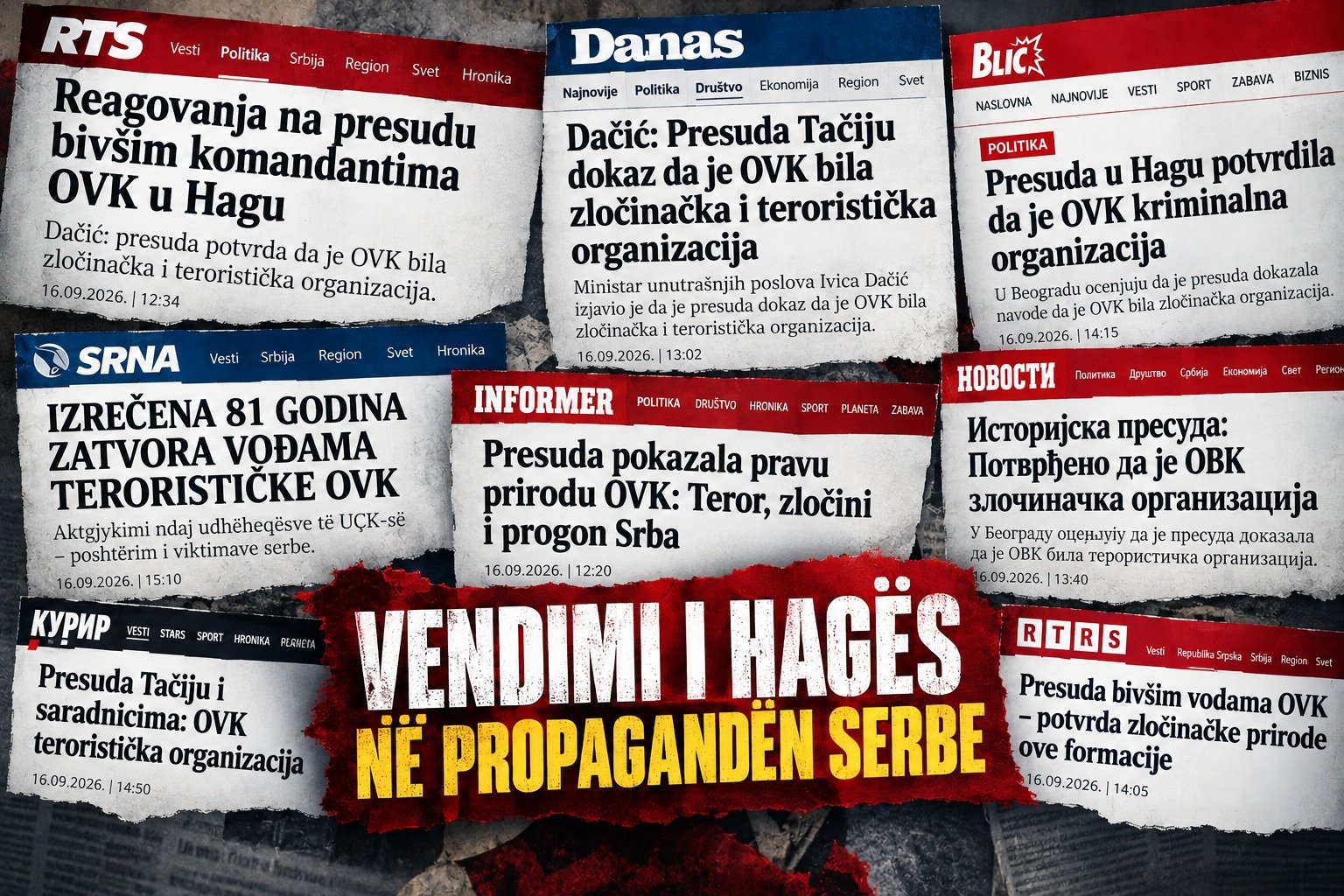
Serbia’s Interior Minister, Ivica Dačić, described the Hague decision as a “confirmation” of what Serbia and the Serbs, according to him, had been saying for more than two decades, claiming that it had discredited the narrative of the KLA as a liberation force and its war as a “legitimate armed struggle for liberation” (RTS, 16/09/2026). This approach is not new. It should be viewed as part of a structured strategy of political narrative-building in Serbia, in which the victimization of Serbs occupies a central place in the interpretation of the Kosovo war and NATO intervention. Through this strategy, the “suffering” of Serbs is placed at the center of public memory and discourse, while the circumstances that led to the armed struggle for freedom are not mentioned at all. In particular, the systematic repression of Kosovo Albanians, the killings and massacres committed against the civilian population, as well as the mass expulsion of Albanians during the war are omitted (HRW, 2001). Thus, the Hague decision has arrived in a political and media environment already prepared to appropriate it as “evidence” of a narrative built decades ago. In other terms, this represents a shift from “justice” to propaganda: a judgment that establishes “individual criminal responsibility” is interpreted in Serbian political discourse as a ‘’evidence’’ on the character of the KLA and it’s struggle for freedom. Coverage by media outlets closely associated with the Serbian authorities reflected a similar narrative. The SRNA news agency titled its report “81 Years in Prison for Leaders of the Terrorist KLA,” framing the KLA as “terrorist” already in the headline, while RTRS published the reaction of the Minister of Justice of Republika Srpska, Goran Selak, under the headline “Acquittal of Crimes Against Humanity Is an Insult to the Victims.” In another SRNA report, Selak’s position was summarized in the headline “Judgment Against Leaders of the Terrorist KLA – Humiliation of Serbian Victims” (SRNA, 16/09/2026; RTRS, 16/09/2026).
This is neither more nor less than a continuation of an already well-known manipulation of historical memory and political narrative in Serbia: “Serbia as a victim, Serbs as victims, Albanians as aggressors, and the West as an actor that legitimized the aggressor.” The Hague judgment is incorporated into this framework as a new element of authority. So, the narrative of victimization itself is not new, what is new is the attempt to give it a renewed international legal seal of approval. The judgment convicting KLA leaders is being used by the authorities in Belgrade as “evidence“ that their “historical” narrative has been “validated” by international justice. This is precisely why Dačić’s statement has a political dimension beyond its stated content, because, according to him, the judgment had undermine the notion of “liberation war.” This should be understood as an attempt to stigmatize and delegitimize our struggle for freedom. Such a rhetorical framing seeks to politically instrumentalize a judicial decision, extending the narrative not only to our liberation war itself, but also to the state of Kosovo, which became a reality as a result of the same struggle for freedom and NATO’s military intervention to stop the ethnic cleansing in Kosovo (NATO, Kosovo: The Real Story, 06/04/2000).
Recent research on the politics of memory in Serbia provides grounds for such an interpretation. In her article “Why and how victimhood matters? Between strategic ontological narratives and intersectional injustice in contemporary Serbia,” Jessie Barton Hronešová argues that Serbian political elites have strategically used narratives of “victimhood” and “historical injustice” to strengthen a political identity rooted in interpretations of the past and to legitimize current political positions. According to the author, during long tenure in power of Aleksandar Vučić, victimhood has become a centralized framework of political communication, articulated through his personal appearances and pro-regime media (Hronešová, 2025:533-538). In the case of Kosovo, this narrative seeks to portray Kosovo Serbs as a “threatened” community and Serbia as a subject of continuing “injustices” at the international level. Therefore, the instrumentalization of the judgment should not be analyzed as a spontaneous reaction to a judicial decision. It should be viewed as part of a structured system of Serbia’s strategic communication aimed at producing, consolidating and promoting political narratives about the past and collective memory (Fetoshi, 2026). Studies on Serbian nationalist discourse has consistently documented that the media have played an important role in reproducing the image of Serbs as “victims” of Kosovo Albanians. This narrative pattern has deep roots in Serbian public discourse. Erjavec and Volčič (2007), in their analysis of Serbian media, found that the dominant nationalist discourse portrayed Serbs as victims of Albanians. According to the authors, this framework also relied on the appropriation and adaptation of international discourses on the “war on terror” and “crime,” which, when adapted to the Serbian political context, served to portray Albanians as a source of “threat” and to legitimize the nationalist interpretation of the conflict (Erjavec & Volčič, 2007:67-68; Erjavec & Volčič, 2007:123-124).
The Hague decision, as part of an international judicial process, provides Serbia with an opportunity to instrumentalize it in the service of an already consolidated political narrative concerning Kosovo, transforming it into a narrative reinforced by international legal authority. For Serbian political propaganda, this is highly useful: a narrative previously shapedby politics and the media is now presented as being validated by an international court. The Serbian authorities and media outlets aligned with them are recontextualizing and integrating it into an already established communication strategy, giving their interpretation additional weight by invoking the international nature of the judicial process. Within this approach, the Hague judgement represents a further element within an existing narrative framework. The 1999 bombing, “Serbian victims,” the “expulsion of Serbs” after the war, the “crimes of the KLA,” and the Hague judgment are placed within a single established narrative framework. The intended conclusion is clear: Serbia was and remains a “victim,” Albanians were “aggressors,” and international intervention was “unjust” toward Serbia. Thus, a court decision in 2026 is incorporated into a political and media discourse that goes beyond the criminal proceedingsthemselves and seeks to reshape interpretations of the Kosovo War and to undermine the state of Kosovo.
Media Framing in the Service of Political Objectives
The instrumentalization of the Hague judgment becomes more understandable when viewed in the context of the Serbian media system. The problem is that the Serbian media space is unequal and that pro-regime media have a significant advantage in terms of access, reach, and influence. According to Freedom House, ruling parties in Serbia have expanded their influence over the media through control of state-owned enterprises and private media outlets that depend on government funding. The report also emphasizes that the media environment is characterized by propaganda and the manipulation of facts on certain issues, including Serbia’s policy toward Kosovo (Freedom House, 2024). Reporters Without Borders (RSF) similarly describes the media environment as one in which propaganda and disinformation coexist with professional journalism, while media outlets critical of the government face political and economic pressure (Reporters Without Borders, 2026). In such a media system, largely controlled by the government, the way a judicial decision is reported contributes deliberately to transforming it from a legal act into an instrument of political discourse. Headlines, the selection of statements, the use of visuals, and the repetition of terms such as “terrorists,” “criminals,” “Serbian victims,” and “international injustice” shape public perception and interpretation of the event before the public has had an opportunity to examine the legal substance of the judgment. This is a classic and well-known mechanism of Serbian propaganda, it is not always necessary to invent a fact, it is enough to construct a hierarchy of facts. The conviction of the four KLA leaders becomes the main headline, the absence of convictions for crimes against humanity becomes a secondary detail, or is not mentioned at all, while the broader context of the war and the documented crimes committed by Serbian forces against Albanians remain outside the frame of the news.
This narrative approach is consistent with patterns documented across a broad range of academic studies identified as the politics of victimhood in Serbia. As Jessie Barton Hronešová argues, Serbian political elites have used victimhood to portray Serbia as a continuing object of external injustice and hostility. According to her, this narrative has been disseminated through centralized political communication and pro-regime media (Hronešová, 2025:538–539). This is also where the most problematic aspect of the instrumentalization becomes apparent. Belgrade does not use the judgment decision to seek justice, but reintroduce into public discourse the question concerning the legitimacy of the Republic of Kosovo. In the official statement of the Serbian government, Ivica Dačić directly linked the decision to the claim that Kosovo cannot be built upon the “mass graves” of Serbs (Government of Serbia, 2026). This communication strategy is closely connected to the broader historical development of the Serbian media. In her analysis entitled “Kosovo 1989: The (Ab)use of the Kosovo Myth in Media and Popular Culture,” Radina Vučetić (2021) clearly argues that the political use of the “Kosovo myth” and the portrayal of Albanians as a threat have a much longer history, and that the media have been a central instrument in this process (Vučetić, 2021:227-228, 239-240). Therefore, the 2026 Hague judgment does not create the narrative of Serbian victimhood, it provides it with a new symbolic source. Although the narrative predates the judgment, it can now be presented as, “Even the Hague confirmed it.” This formula has significant propagandistic potential because it presents a pre-existing political interpretation as the consequence of a judicial decision.
The problem with Serbian propaganda does not lie in its portrayal of victims as such. Rather, it lies in the monopolization of the image of the victim and its use to construct a history in which Serbia is perpetually the victim, while its historical responsibility is relegated to the background. The Hague decision has been incorporated into this mechanism as a new link. It is used to reinforce a narrative that did not begin in 2026 and will not end with this judgment. The core of the instrumentalization of the Hague decision by Serbia’s political and strategic communication lies precisely in the attempt to project the judgment beyond legal responsibility and to use it to interpret the history, war, and statehood of Kosovo.