

Authors: Arben Fetoshi & Gjon Culaj
Beyond the constant manipulation in the service of power, whenever Serbia faces domestic political crises, particularly during election campaigns, Kosovo returns to the forefront of Its nationalist rhetoric. It is used as a symbol of the strategy of “victimization,” as a catalyst for electoral mobilization, and as an instrument of revisionist politics regarding the “historical injustice”, that must be rectified.
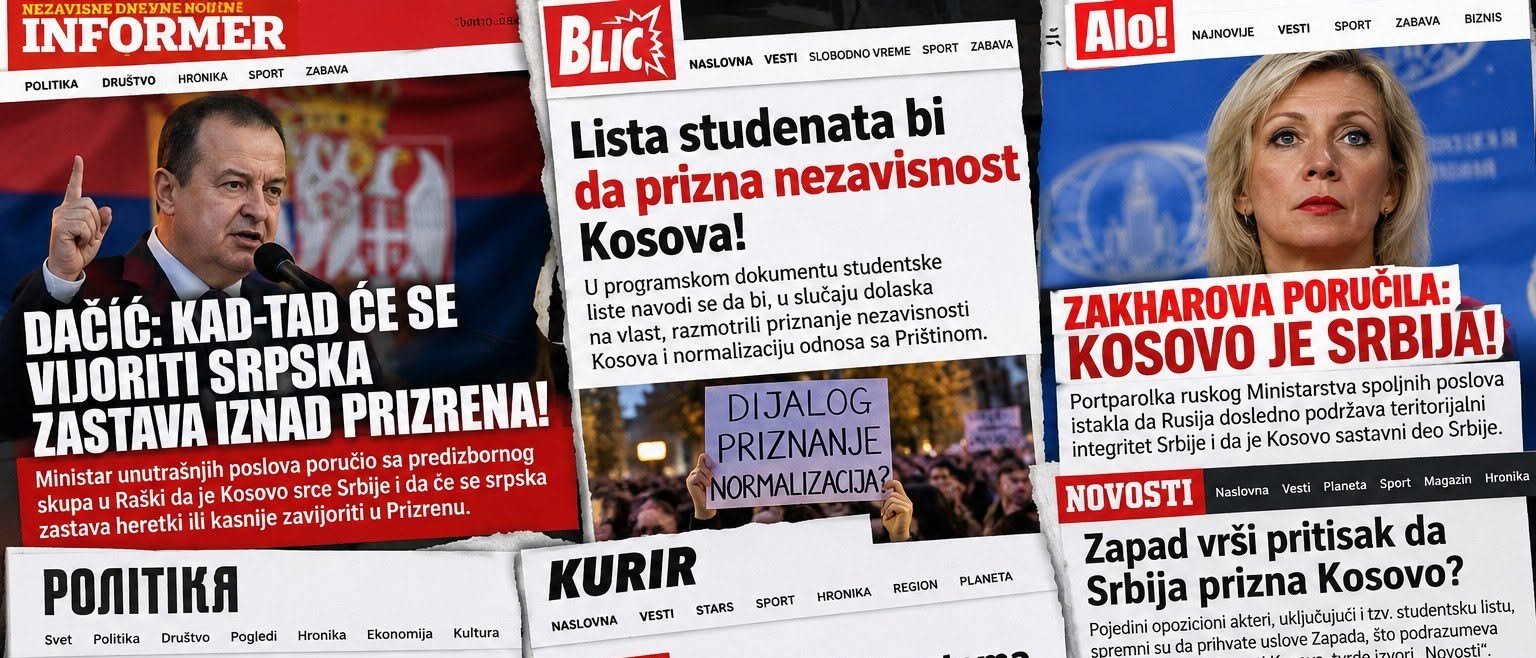
The statement by Serbia’s Minister of the Interior and leader of the Socialist Party of Serbia, Ivica Dačić, that “sooner or later, the Serbian flag will fly over Prizren,” exposes Serbia’s threatening and destabilizing approach towards Kosovo. Delivered at an election rally in Rashka, was more than an expression of nostalgia, it also reiterated Serbia’s refusal to recognize Kosovo’s independence and served as a warning that Belgrade would continue to pursue hybrid strategy intended to undermine stability and obstructing Kosovo`s international consolidation (Danas, 07/10/2026).
In a region still grappling with the consequences of the wars of the 1990s, such a statement cannot be dismissed as an ordinary electoral rhetoric, as it is provocative and threatening because it places a city in Kosovo within a narrative of restoring Serbian control. This rhetoric calls into question Serbia’s declared commitment to “constructive“ engagement in the EU-led dialogue, exposing the gap between its stated commitment to normalization and its actual intentions. For this reason, nationalist rhetoric focused on Kosovo should be recognised as a serious threat to regional peace and security, an obstacle to the normalization process as well as a test of the European Union’s credibility and commitment to stability.
The Frames of Kosovo in Electoral Rhetoric
Dačić’s threat to raise the Serbian flag over Prizren, Vučić’s accusations that the Student List “will recognise Kosovo and impose sanctions on Russia” (Vreme, 11/10/2026), the support for “United Serbia” from the Slovak prime minister, who promised at a meeting organised by this political group that he would “never let them down when it comes to Kosovo” (Klix.ba, 16/10/2026), Russian support expressed by Maria Zakharova through the slogan “Kosovo is Serbia” (Politika, 16/10/ 2026), Petar Petković’s portrayal of Albin Kurti as an “enemy” and his claim that Kurti supports the Student List (NIN, 09/10/2026), claims by opposition figures Jovanović and Gajić about “bringing Kosovo back” (N1, 10/10/2026), as well as the support given separately, but for similar reasons, by the Serbian List and the Serbian opposition in Kosovo (RFE/RL, 24/09/2026), are among the identified frames of instrumentalising Kosovo as a common denominator in the race ahead of Serbia’s 25 October elections.
These developments not only shape the position of any future government towards Kosovo, but also point to the continuation of Serbia’s geopolitical alignment with Russia. The students’ response regarding sanctions against Russia not only confirms this trend, but also reveals that they envisage “defending” Kosovo through Moscow (Mašina.rs, 30/09/2026). Aleksandar Vučić remains at the forefront of this rhetoric, repeatedly stating that he will “never recognise Kosovo” (Tanjug, 14/10/2026), despite the fact that such a position undermines dialogue and holds Serbia hostage to a destabilising political course. (Hehir, 2025:15).
Challenging Vučić does not, however, mean breaking with the nationalism that has shaped Serbian politics for decades (Vulović, 2023:530). As Boris Varga of the Centre for Western Balkans Studies points out, parts of the opposition and the Student List also rely on the same narratives about Kosovo (Varga, 2026). Thus, Kosovo once again takes centre stage in the election campaign, overshadowing concerns that directly affect Serbian citizens. Meanwhile, Russia has been invited to observe the elections, reflecting its perceived role as a source of political legitimacy. Russian Foreign Ministry spokesperson, Maria Zakharova, confirmed that Russia would send representatives from both chambers of parliament, members of the Central Election Commission, and observers as part of the OSCE/ODIHR mission (RT Balkan, 21 October 2026).
The Consensus That Holds “Normalisation” Hostage
The lack of accountability for the terrorist attack in Banjska (2023), Serbia’s alleged involvement in the attack on the Ibër-Lepenc canal (2024), its continued rapprochement with Russia, and the intensification of its aggressive attitude towards Kosovo in both domestic and international rhetoric inevitably undermine the normalisation process mediated by Brussels (European Commission, 2025: 65).
The European Union cannot limit itself to calls for restraint, calm and the continuation of dialogue while threatening statements by Serbian politicians about raising the “flag over Prizren” continue. Dialogue cannot succeed if Kosovo faces penalties for its lawful actions while Serbia is ‘rewarded’, despite its strategic divergence from the EU’s foreign policy. The mediator’s credibility and the success of the process depend on applying equal standards to both parties and conditioning Serbia’s progress on respecting and implementing the commitments it has undertaken (Pavković et al., 2026).
Without accountability, calls for dialogue remain empty rhetoric, while the lack of political consequences for Serbia raises questions about the seriousness of the international community’s commitment. If the EU claims to be a credible mediator, it must clearly explain what it expects from each party, which violations have been documented, and what political and economic consequences will be imposed in the event of non-compliance (Stepaniuk, 2023:94-95).
This would provide the clearest evidence that its standards are applied consistently, regardless of a country’s geopolitical influence. The current campaign for the 25 October parliamentary elections has shown that parts of the opposition and the Student List adopt an even more hard-line nationalist approach. This has also been noted by journalists Iva Martinović and Dušan Komarčević in their article, “What Message Are Serbia’s Protest Students Sending with Their ‘Memorandum’ on Kosovo?”, published by Radio Free Europe on 19 May this year (Martinović & Komarčević, 2026).
For Kosovo, the message remains clear: Vučić’s removal from power alone would not be enough if the political ideas of the opposing camp remain the same. An opposition that refers to Kosovo as a “territorial seizure” and a Student List that considers it “part of Serbia”, while rejecting sanctions against Russia (CFWBS, 02/10/2026), can hardly offer a credible alternative for “normalisation” or deliver on the promise of a democratic transformation of Serbia.