

While enjoying the sun on the shores of the Aegean Sea, the symbolism of the beach and the wisdom of two distinguished thinkers expose both Vučić and the grand deception surrounding Vidovdan.
In a place where differences seemingly disappear, and where Greeks, Albanians, Serbs, and other holidaymakers are united under the same sea and sun, the philosopher of those distant shores, Heraclitus, demonstrated 2,500 years ago that change is an irreversible process and that history, like his river—into which one cannot step twice—cannot be taken back 28, let alone more than 100 years.
Much later, thirty-five years ago, Ukshin Hoti reminded Serbia that history cannot be commanded and that interpretations driven by hegemonic interests turn Kosovo into a cult of its own captivity (The Political Philosophy of the Albanian Question, Rozafa, 1995).
More than twenty-seven years after the war, and despite the peaceful coexistence without distinctions on the beaches of the Aegean, Vučić’s Serbia continues to instrumentalize history by nurturing the very myth that has drenched it in blood.
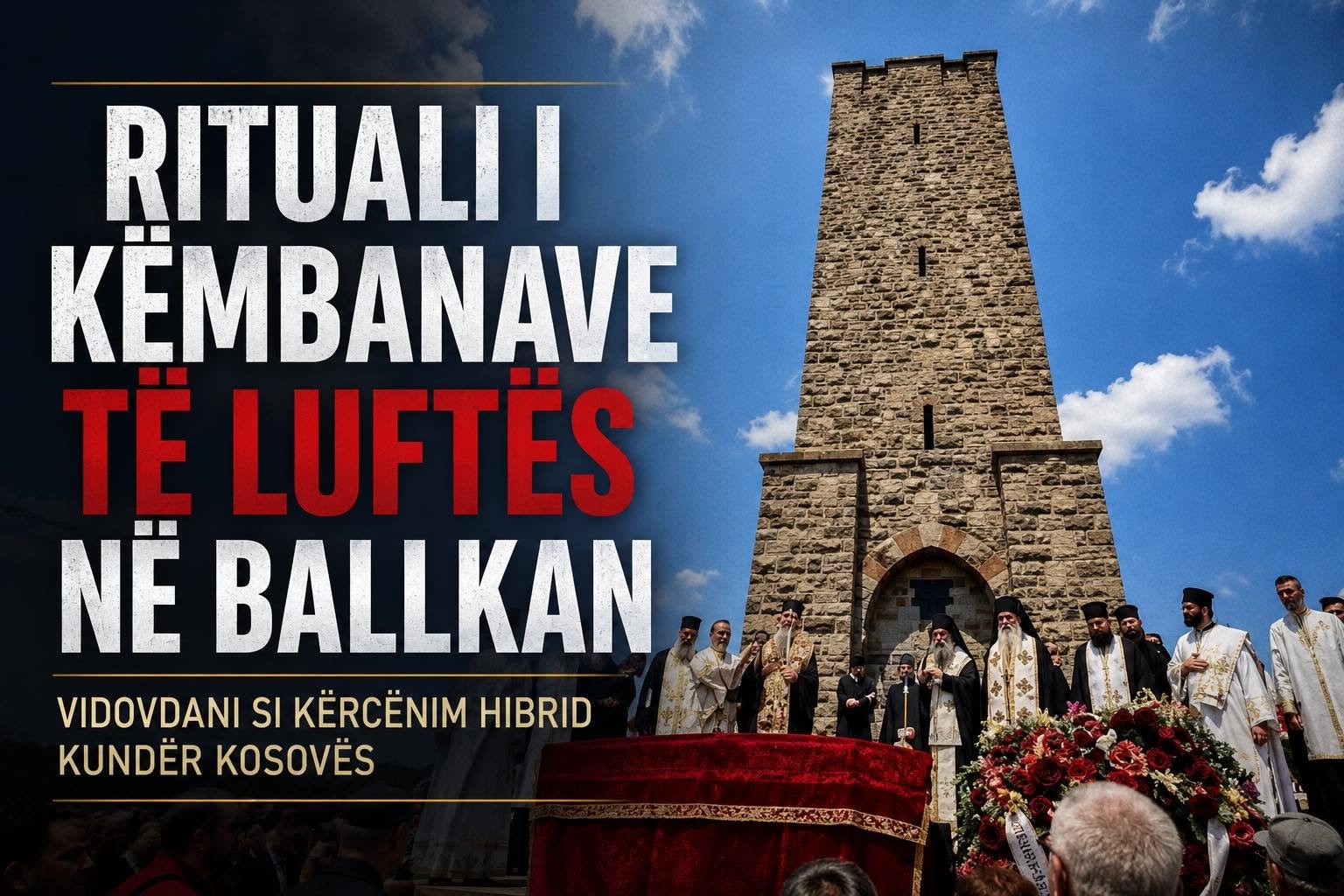
Vidovdan is no longer merely a historical or religious anniversary; it has evolved into a ritual of calls for conflict and violence. Within Serbia’s post-Milošević hybrid strategy, Vidovdan functions as a mechanism for sustaining the manipulative narratives of the “Serbian World”: victimhood, the “sacred” land, and the alleged aggression of the West.
Sacralization and the Battle of Kosovo
A historical event representing the Balkan resistance against Ottoman expansion (Muhadri, 2021; Malcolm, 1998) has been appropriated as a foundational moment of Serbian national identity and as “evidence” of Serbia’s alleged perpetual right to Kosovo (Ković, 2023; Serbian Orthodox Church, Diocese of Raška and Prizren).
The Battle of Kosovo constitutes the cornerstone of Serbian Orthodox nationalism, sustained by a myth that serves collective consciousness, religious faith, and “patriotic” mobilization. In this narrative, facts are secondary; interpretation is what truly matters.
Only three years after the Memorandum of the Serbian Academy of Sciences and Arts (1986), which articulated the narrative of “Serbian victimhood,” Slobodan Milošević commemorated the battle’s 600th anniversary at Gazimestan in Kosovo Polje, using the occasion to launch the project of a Greater Serbia under the guise of “protecting” the Serbian people. What followed was systematic violence, war, massacres, and genocide in Croatia, Bosnia and Herzegovina, and Kosovo (HRW, 2001).
In 1999, NATO’s intervention forced a change in the narrative, but not in its essence: the denial of war crimes, the portrayal of Kosovo as the “heart of Serbia,” and the claim that it had been “temporarily seized” through Western aggression.
This is the version of history taught to students participating in the Serbian Orthodox Church’s “Spiritual School of Prizren,” while young generations are inspired through the “Vidovdan Covenant.” In this way, historical truth is manipulated, and the Battle of Kosovo is appropriated to serve contemporary expansionist objectives.
Kosovo is sacralized so that it cannot be negotiated. Sacredness leaves no room for compromise. In Brussels, Serbian officials seek recognition as “constructive” interlocutors, yet they refuse to accept the earthly reality of the Republic of Kosovo.
In this sense, Vidovdan functions as an instrument of rejection and continues to obstruct the normalization of relations. If Heraclitus’ truth remains unconvincing despite the boundless sea of possibilities offered by modernity, Ukshin Hoti’s truth is far more difficult to ignore.
The story of his isolation, imprisonment (1981, 1993, and 1994), persecution, and eventual disappearance in 1999 represents a constant feature of Yugoslav and Greater Serbian policy, both before and after Milošević. Imprisoned within the “captivity” of the Kosovo cult and obsessed with denying “the recognition of Albanian history,” they chained him, publicly vilified him, tortured him, and made him disappear without a trace. Yet, despite all this, they could not command history.
Victimhood Under Ukshin Hoti’s Test
A battle lost to the Ottomans, yet one in which Prince Lazar was “sacrificed in defense of Christianity.” This is the ecclesiastical narrative surrounding Prince Lazar’s choice of the “Heavenly Kingdom,” upon which the sacralization of Kosovo has been constructed. It is an amalgamation of selectively interpreted historical facts and ecclesiastical martyrdom, designed to “sanctify” Kosovo as the cornerstone of Serbian national identity. This narrative of victimization continues to be elaborated as historical truth through textbooks, religious sermons, and political discourse to this day.
It is irrelevant whether the historical facts suggest otherwise. It is irrelevant that violence, massacres, and the mass expulsion of Albanians from Niš, Toplica, Leskovac, Kuršumlija, Vranje, and other regions occurred during 1877–1878 (Malcolm, 1998). Nor does it matter that Milošević pursued the very same objective through Operation Horseshoe in 1999. What matters is that NATO’s intervention, which prevented ethnic cleansing in Kosovo, is framed as an act of aggression, while the Battle of Kosovo, Vidovdan, and Gazimestan continue to serve as instruments of Serbia’s narrative warfare against Kosovo.
Within this framework, victimization functions as a strategy for evading responsibility for war crimes committed in Kosovo while simultaneously serving as propaganda for emotional mobilization, reinforced through religious authority. Today, this victimization narrative targets Kosovo’s state institutions, the Kosovo Police, and the judicial system.
Claims of repression and terror against the “Serbian people” (Petković, 25 June 2026), together with allegations that the Kosovo Liberation Army’s (KLA) wartime “crimes” are “deliberately left uninvestigated” (B92, RTV, Tanjug), seek to demonize the Republic of Kosovo, mislead international public opinion, and obstruct the integration of the Serbian community into Kosovo’s institutional framework.
Millovan Drecun attempts a reversal of roles by portraying the arrests of Serbs in connection with the Račak case as an effort to overshadow alleged KLA crimes on the eve of the Hague’s decision. Drecun himself has publicly stated that Serbian authorities supplied the Specialist Chambers with thousands of pages of evidence (RTS, 2023). Yet, paradoxically, they have still failed to substantiate the alleged “KLA crimes” against the approximately 500 missing Serbs in Kosovo.
Meanwhile, in an effort to relativize Serbia’s own responsibility, the Račak massacre continues to be dismissed as a “conspiracy” (YIHR, 2019), largely because of the credibility and role of Ambassador William Walker. At the same time, there is complete silence regarding the massacres in Krusha, Fortesa, Celina, Meja, and more than 150 other massacre sites across Kosovo.
Velko Odalović, the Serbian Government’s Commissioner for Missing Persons, has likewise aligned himself with Drecun by describing the victims of the Račak massacre as terrorists (Kosovo Online, 25 June 2026). By this logic, Ukshin Hoti would presumably also have been considered a terrorist, despite the fact that he disappeared while handcuffed in state custody. It is therefore unsurprising that, during his tenure as head of the Government Commission on Missing Persons, Odalović never saw fit to tell Andin what had happened to his father—or where he was.
The Power Game and the “Injustice” of the West
The fact that, even twenty-seven years after the war, fabricated allegations against the Kosovo Liberation Army (KLA) continue to circulate and re-emerge within Serbia’s strategic communication confirms their enduring political and international function. In the domain of hybrid warfare, the significance of such claims lies not in their factual accuracy but in their effectiveness in shaping public perception.
The narrative of “KLA terrorism” serves a dual purpose: it targets both the independence of Kosovo and the alleged “injustice” of the West. It is employed to justify Serbia’s militarization under the guise of “self-defense” through strategic alignment with Russia and China, while simultaneously fostering domestic mobilization through narratives of victimhood and the symbolism of Vidovdan.
In this power game, Aleksandar Vučić relies on the symbolism of national pride, military strength, and economic development. Ahead of Vidovdan, he organizes highly symbolic public events and religious ceremonies, mobilizes electoral support in Belgrade, and showcases newly acquired military systems on 28 June (RTS, 25 June 2026).
Confronted with mounting anti-government protests and the approaching end of his presidential mandate, Vučić stood beneath a giant Serbian flag to stage a symbolic “ballot” on citizens’ priorities, presenting a political platform centered on “unity” (“Serbia, One Family”), the “defense” of Kosovo, and economic development.
Despite the International Court of Justice’s Advisory Opinion (ICJ, 22 July 2010), Kosovo’s recognition by 121 states, and ongoing normalization efforts within the Brussels Dialogue, Vučić continues to invoke international law selectively, denounce the alleged injustice of the West, and pledge the eventual return of what he calls “their land” (Kosovo Online, 21 March 2026).
According to this political logic, Heraclitus is right only if his philosophy validates Serbia’s claims. For this reason, Vidovdan should be understood and exposed as a hybrid operation:
- The Battle of Kosovo was not an exclusively Serbian historical event and cannot serve as the basis for contemporary political claims over Kosovo;
- Serbia cannot evade state responsibility for the war crimes and genocide committed in Kosovo;
- NATO was not an aggressor, but the force that prevented the ethnic cleansing of Kosovo.
As long as Kosovo continues to be treated as a myth rather than accepted as a political and legal reality, Vidovdan will remain the ritual of the bells of war in the Balkans.