
Author: Gjon Culaj – External Associate at the “Octopus” Institute
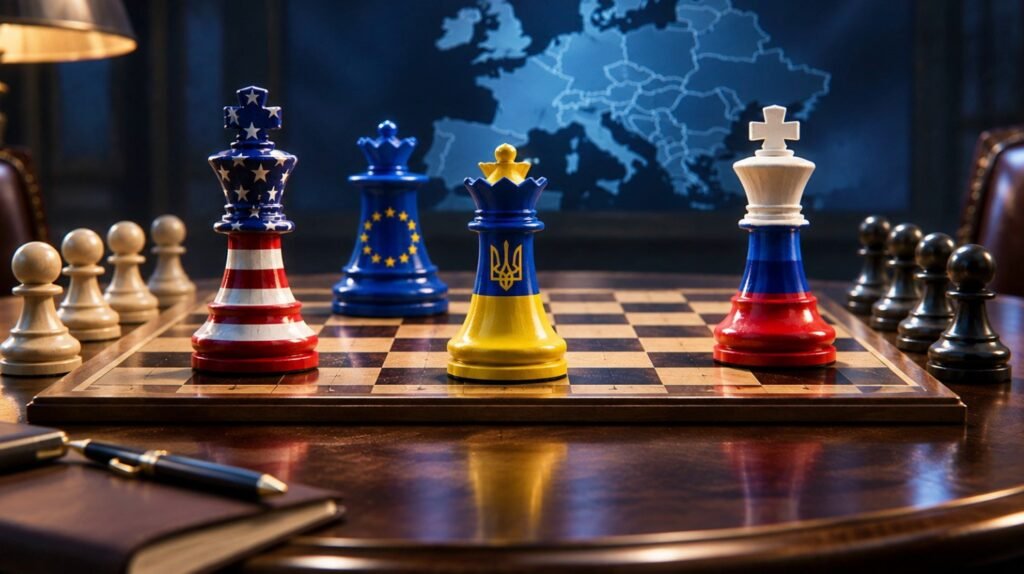
The War in Ukraine has sparked an in-depth debate on the European security architecture, geopolitical competition, and economic consequences, thereby seriously challenging the functioning of the international order established particularly in the aftermath of the Cold War. Although the diplomatic efforts in Abu Dhabi (10 and 11 November) between the United States, Russia, and Ukraine did not result in any concrete agreement, they highlighted that this conflict is not merely a military confrontation between two countries, bringingfundamental issues of international relations back into focus, such as the balance of power and the principles of collective security.
Although the negotiations were initially aimed at reaching an agreement to end the nearly five-year-long war, they took a different direction, albeit not entirely unexpected, shifting towards discussions on the future architecture of European security. According to an analysis by the Centre for Eastern Studies (OSW), these negotiations failed almost entirely to achieve a compromise on a ceasefire, while issues concerning territorial matters were not even addressed during the discussions (Rodkiewicz et al, 2026). For this reason, Abu Dhabi produced a diplomatic paradox: Russian aggression against Ukraine was overshadowed, while the future of European security became the central topic of discussion. Therefore, from now on, discussions and negotiations are likely to extend beyond the question of how to bring the war to an end, towards the broader question of what kind of Europe will emerge in its aftermath. Because, for Russia, Ukraine is not the ultimate objective, but a pathway towards a much broader agreement (Barbashin, 2026).
European Security, the Balance of Power, and the Security Dilemma
To better understand the developments in Abu Dhabi, John J. Mearsheimer’s theoretical approach of offensive realism is also helpful. In his work “The Tragedy of Great Power Politics“ (2001), Mearsheimer argues that great powers seek to maximise their power and ensure their survival through influence and positioning within the international system. According to this author, whose arguments continue to be used by Russia to legitimise its strategic narratives, security depends not only on the peaceful intentions of states but also on their position and military capabilities in relation to other states (Mearsheimer, 2001: 29-33). On this basis, Russia’s response to NATO’s eastward expansion is perceived as a form of strategic competition in a region that it seeks to transform into its own sphere of influence (Goldgeier & Itzkowitz Shifrinson, 2020:291-294). However, in his critique of Mearsheimer, John M. Owen points out that his interpretation is inconsistent with the very logic of realism.He argues that if Russia’s actions are understood as a reaction to NATO’s eastward enlargement, then the aspirations of Eastern European states to join the Alliance should also be interpreted as a response to the security threats they perceive from Russia (Owen, 2022).Therefore, the confrontation between the two security approaches in this case is inevitable:on the one hand, Russia considers the potential enlargement of NATO a threat to its strategic position, while, on the other hand, states aspiring to join Euro-Atlantic structures, such as Ukraine, view any constraints on their strategic orientation as unjust and as an infringement on the sovereignty of alliances and their right to determine their own future (Smith, 2024:501-507).
Mearsheimer’s approach helps explain why negotiations concerning Ukraine are not exclusively about territorial issues, but also about determining the balance and distribution of power in Europe. This argument, however, does not in any way justify Russian aggression against Ukraine. States seek to preserve the balance of power through political and military alliances and this balance has been maintained for a long time thanks to transatlantic relations and the collective defence guaranteed by NATO. Nevertheless, the war in Ukraine and the recent debates surrounding negotiations with Russia have once again exposed a structural problem within Europe, namely the lack of European strategic autonomy and its dependence on American military capabilities and potential in the field of defence (Helwig, 2023:58-61). In this context, Abu Dhabi may serve as a test of transatlantic unity while also highlighting the need for Europe to strengthen its strategic autonomy as a prerequisite for fulfilling its ambitions of becoming a more influential political and military actor in international affairs.
It is precisely in this direction that the reactions of European leaders point, as they refuse to separate Ukraine from the future security of the continent. According to French President Emmanuel Macron, Europe must independently determine its own security architecture and shared strategic vision through strategic autonomy, which entails independently safeguarding European interests (Euronews, 12/11/2026). Accordingly, the reaction of German Chancellor Friedrich Merz was even more direct, emphasising that “decisions about Europe’s future cannot be made without the participation of Europeans themselves” (Reuters, 14/11/2026). These positions clearly indicate that, beyond political unity, Europe needs, more than ever, strong political, economic, and military capabilities as an indispensable condition for Europe’s role in geopolitical competition and the international balance of power.
From this perspective, European responses highlight three issues of strategic importance:
a) No decisions concerning the architecture of European security can be made without their involvement;
b) NATO remains the cornerstone of the defence of the Euro-Atlantic order (European Council, 10/11/2026); and
c) The need to strengthen European defence capabilities as a strategic necessity in response to the ‘’uncertainty’’ and ‘’dilemma’’ over the future of American security commitments in Europe.
Implications for the Western Balkans: The Case of Kosovo
Despite its geographical distance from the Russian-Ukrainian war front, the Western Balkans remains a strategic region where any potential shift in the European balance of power could have direct consequences for peace and security. The region continues to face political, economic, and security challenges, largely due to political and territorial disputes, external influences, as well as the prolonged and uncertain nature of Euro-Atlantic integration processes. The Russia-Ukraine War has increased the strategic importance of the region for both the EU and NATO. In September of this year, the European Parliament’s report, “Paving the Way to EU Enlargement: Assessing Potential Implications on Security and Defence”, frames EU enlargement almost entirely as a matter of European security, identifying, among other issues, the Kosovo-Serbia dispute as a factor hindering cooperation and sustainable regional peace (Ioannides, Centrone & Fernandes, 2026).
Serbia continues to be Russia’s strategic lever in the Western Balkans, providing Moscow with an avenue for exerting influence in opposition to the region’s Euro-Atlantic orientation. Even more concerning is the fact that this foreign policy orientation of Serbia remains unchanged despite the political transition and the Student List’s accession to power. A comparative analysis of this recent development was provided by Arben Fetoshi, Director of the “Octopus” Institute. According to him, the political programme the incoming political leadership in Belgrade does not represent any change in Serbia’s foreign policy or strategic orientation, confirming Belgrade’s geopolitical continuity in its relations with Kosovo, Russia and China. Furthermore, in his analysis, Fetoshi highlights a particularly interesting element: Serbia regards the EU as a “wallet, not a strategic orientation”, meaning that it seeks to benefit economically from the EU without clearly defining European integration as its strategic orientation (Fetoshi, 2026). Serbia’s position towards Kosovo, its relations with Russia and China, and its Euro-Atlantic cooperation remain largely unchanged from those of the previous Vučić regime. As result., Serbia continues to be held hostage by its past and remains a source of threat to regional peace and security. Nevertheless, from the talks in Abu Dhabi to the debates surrounding the future of European security, and the emergence a new political leadership with an old political programme in Belgrade, Kosovo must continue to approach its national security not merely as a matter of territorial defence, but as an inseparable part of its Euro-Atlantic strategic orientation.