
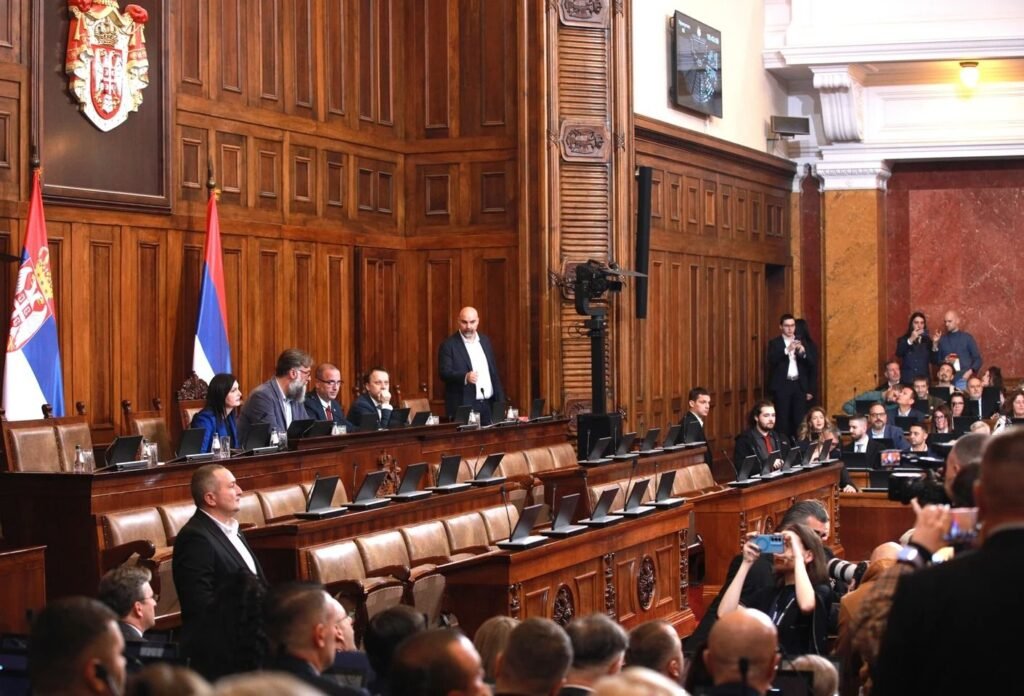
The Geopolitical Continuity of the New Political Power in Belgrade
The political programme of the Student List, through which it claims to pursue Serbia’s democratic transformation, contains no change in its foreign policy orientations. “Military neutrality”, Kosovo as part of Serbia, the refusal to impose sanctions on Russia, the strategic partnership with China, the economic partnership with the European Union, and the strategic dialogue with the United States of America constitute the main commitments of the chapter “Foreign Affairs and National Interests”, demonstrating complete geopolitical alignment with the programmes of previous governments under the presidency of Aleksandar Vučić.
Beyond programmatic and discursive nuances, this is the conclusion emerging from a comparison of the Student List’s programme with the programmes of the governments of Miloš Vučević and Đuro Macut, as an adapted continuation of Serbia’s hegemonic objectives in the region.
Camouflaged “Neutrality”
“In accordance with the Resolution on the Protection of Sovereignty, Territorial Integrity and the Constitutional Order of 26 December 2007, we will preserve military neutrality as Serbia’s strategic orientation,” the chapter “Foreign Affairs and National Interests” specifies (Student List, Foreign Affairs), while the chapter “Defence” elaborates the objectives of modernising, professionalising and technologically advancing the military (Student List, Defence).
Just like the programme of the Vučević government (2024), which defined “political independence and military neutrality” as the two pillars of foreign policy, or that of the Macut government (2025), which linked “neutrality” to strengthening defence capabilities, the Student List also camouflages itself behind “strategic neutrality”, which has so far served as a “façade” for militarisation and rapprochement with Russia and China (Morina, 2022; Serbia Report 2026). In this context, the “students’” programme does not envisage a reduction in military power, but rather increased investment and an integrated air defence system with a range of up to 300 kilometres.
Compared with previous governments, the programme differs only in its recruitment model and financial and social package, promising higher base salaries, allowances and favourable housing loans for soldiers. While the acting Minister of Defence, Bratislav Gašić, had stated that they were ready for compulsory military service from March 2027 (Tanjug, 07.07.2026), the Student List has opted for voluntary service, giving priority to a professional army.
Kosovo “part of Serbia”
A comparison of the Student List’s programme with the government programmes of Vučević (2024) and Macut (2025) also identifies complete alignment in their position towards the Republic of Kosovo. “We will fight to preserve Kosovo and Metohija as part of Serbia, in accordance with the Constitution and Resolution 1244. We will consistently oppose the unilaterally declared independence of the so-called Republic of Kosovo and will not allow its membership in international organisations,” the Student List’s programme states, among other things (Kosovo and Metohija), displaying precisely the same position as previous governments, including regarding Serbia’s accepted obligation not to obstruct Kosovo’s membership in international organisations (Brussels Agreement, 27.02.2023).
While Vučević treated the “defence” of Kosovo as a challenge to sovereignty and a diplomatic confrontation with the West (Kosovo Online, 01.05.2024), and Macut as a constitutional and national obligation (Exposé, 15.04.2025), the Student List repeats the same objective, referring to the Constitution and Resolution 1244. This means that the change of government in Serbia has not only failed to bring a change in its position towards Kosovo, but has hardened it in relation to the agreements of the Brussels dialogue. It pledges to “criminally prosecute representatives of the regime for any possible criminal offence related to the conclusion and implementation of unconstitutional agreements to Serbia’s detriment”, while announcing that all such agreements will be subject to constitutional review.
Apart from this point, the other commitments are the same, including efforts to secure the broadest possible autonomy not only for Serb-majority municipalities but also for other settlements inhabited by Serbs and Gorani, linked into local self-government units; the preservation of educational, healthcare and social institutions, with particular emphasis on the university in North Mitrovica; the protection of cultural and religious heritage and the property of the Serbian Orthodox Church; and others.
Traditional Partnership, No Sanctions on Russia
“We will preserve the traditional partnership with Russia in order to coordinate in the UN Security Council on preserving Serbia’s territorial integrity and resolving outstanding issues of mutual interest. Serbia will maintain its principled position of not imposing restrictive measures on Russia, while also respecting the territorial integrity of sovereign states, including Ukraine” (Student List, Serbia and the World). Thus, the partnership and opposition to sanctions, as the two pillars of Serbian policy towards Moscow, confirm continuity with previous governments, despite differences in their reasoning.
“Coordination” in the Security Council, using the UN as an international platform for propaganda against Kosovo, has been demonstrated particularly by Vučić and his governments (Kosovo Briefing, 07.02.2024; Vučić’s Address, 23.09.2026), while the alignment with the Student List also includes the “condemnation” of the military invasion of Ukraine and the refusal to impose sanctions on Russia. Serbia voted in favour of the UN General Assembly resolution condemning the aggression (ES 11/1, 02.03.2022), and, along the same lines, Vučević and Macut confirmed their support for Ukraine’s territorial integrity while refusing sanctions against Moscow (Reuters, 13.05.2024; Government of Serbia, 29.12.2025).
Nor does the “students’” programme break with previous policy in the energy sector, despite US demands and its sanctions against the company “NIS”. Although it aims to reduce dependence on a single geopolitical actor, similar orientations had already been established by Vučić’s governments, such as interconnectors with North Macedonia and Romania (Student List, Energy).
Strategic Partnership with China
China, too, retains the “strategic partnership”, with a commitment to “expanding cooperation in the economy, infrastructure and high-technology investments”. “We will develop the comprehensive partnership with China and, in future projects, insist on compliance with environmental standards, workers’ rights and occupational safety” (Student List, Serbia and the World).
While the Vučević and Macut governments promoted relations with China through “steel friendship”, infrastructure investments and the purchase of Chinese FK-3 and HQ-17AE defence systems (Government of Serbia, 17.05.2024; Serbian Ministry of Defence, 28.06.2024), the Student List preserves the continuation of the partnership, but without specifying the defence sector. This means that the “students’” programme seeks to change the conditions of cooperation without undermining the strategic relationship built during Vučić’s presidency.
The EU as a “Wallet”, Not a Strategic Orientation
Based on its positions on Kosovo, Russia and China, the Student List’s programme promotes the same approach towards European integration, even marking a significant deterioration that is not merely discursive, by framing the EU as an “economic and financial benefit” and making membership “conditional” on holding a referendum (Politika, 17.11.2026). Whereas the Vučević government (2024) explicitly defined membership as a “strategic objective”, while opposing recognition of Kosovo and sanctions against Russia, as did the Macut government (2025), which linked European reforms to the “needs of Serbia’s citizens”, the Student List defines the EU as the “most important economic partner” because of its funds and investments.
“We will deepen cooperation with the European Bank for Reconstruction and Development (EBRD) and the European Investment Bank (EIB), in order to secure grants and other forms of financial support for development projects of importance to citizens” (Student List, Serbia and Europe). The programme’s explicit commitment to deepening the strategic partnerships already established with Greece, Italy, Hungary and France, as a desired form of bilateral cooperation with other EU member states as well, together with the announcement of a referendum on membership, confirms not only the same “deceptive” approach as that of previous governments, but also the devaluation of the EU as a strategic objective, now not even at the declarative level.
Strategic Dialogue with the United States
In relation to the United States of America, too, the comparison of the Student List’s programme with those of previous governments identifies clear continuity, despite disagreements over Kosovo. “We will develop relations with the USA on the basis of shared interests and greater trust. We will continue the strategic dialogue on telecommunications, energy, transport, artificial intelligence, diversification of gas and LNG supplies, and defence cooperation,” the Student List’s programme states, also envisaging expanded trade and the involvement of the Serbian diaspora in the USA (Student List, Serbia and the World).
The same approach had also been promoted by Vučević, with Serbia’s interest in “the best possible relations with the Americans”, despite disagreements over Kosovo (Kosovo Online, 01.05.2024), and subsequently by Macut, when his Foreign Minister, Đurić, described the launch of the strategic dialogue with the USA as a government priority (Government of Serbia, 28.04.2025). Therefore, the Student List’s commitment to “continuing the strategic dialogue” merely represents the continuation of a mechanism already established by the Macut government, with evident alignment, particularly in the energy sector.
Otherwise, potential rapprochement with the US or reforms benefiting from the EU, would not be a cause for concern if the Student List signalled a geopolitical turn towards the West. Such a development would imply an opportunity for “normalisation” with Kosovo, putting an end to the hybrid strategy of destabilisation and international sabotage.
However, the Student List’s programme, just like Serbia’s policy to date, also presents the US as a benefit of “non-alignment”, rather than as a new geopolitical orientation to be tested through Kosovo and sanctions against Russia. Therefore, the List that brought down Vučić in Serbia is merely an “alter ego” of the Serb List in Kosovo, which will continue its revisionist policy for as long as it continues to be “tolerated”, and will hold Serbia’s genuine democratisation hostage for as long as it does not abandon its chauvinistic ambitions in the Balkans.