

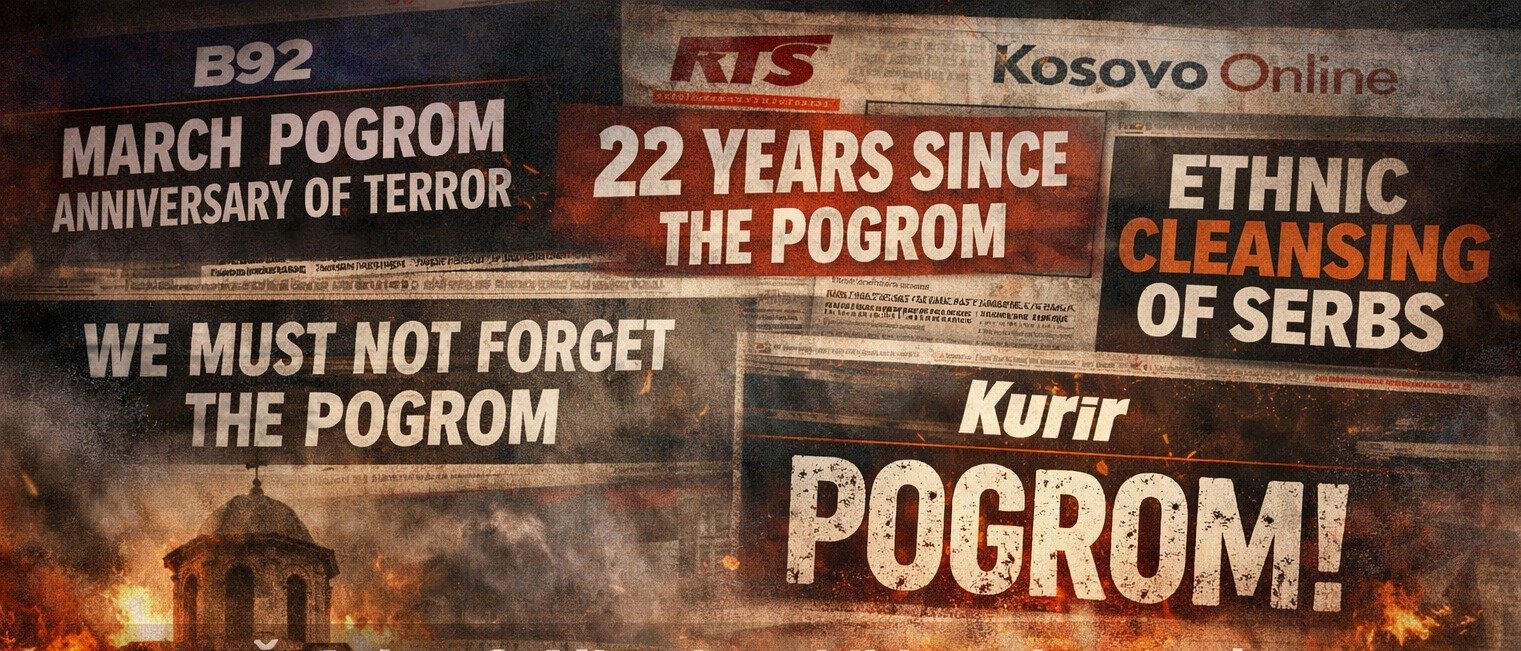
A tragedy that began in the Ibar River, where three Albanian children (Egzon Deliu and Avni and Florent Veseli) drowned while being chased by a group of Serbs, on March 17 and 18, 2004, turned into the most severe episode of post-war Kosovo. Investigations classified the case as murder, yet UNMIK never identified the perpetrators.
The civic revolt that followed continues to be remembered amid ambiguity and politicization. Calculating on public frustration caused by the delay of political status, “someone” provoked public anger, and the consequences severely affected not only human lives, property, monuments, and religious sites, but also the political compromise during the Vienna process.
Decentralization, “protected zones” around Serbian religious sites, and other “privileges” such as language officialization and institutional representation were superimposed as a “necessary need.”
Although more Albanians (11) were killed than Serbs (8), and there were reports of infiltrated BIA “organizers” directing the attacks, the unrest was labeled as an international “failure” and as violence against the Serbian minority.
The Direction of the Revolt as a Scenario
The former Minister for “Kosovo and Metohija,” Goran Bogdanović, himself admitted that he had entered Gračanica with around 30 armed personnel to “protect” the monastery, while today, on the 22nd anniversary of the events, former MUP police officers appeared at the commemorative ceremony organized by North Mitrovica. Naturally, the victims deserve tribute, violence remains condemnable, and the destruction of monuments is unacceptable, as repeatedly stated by international authorities and Kosovo institutions. However, considering reports about certain suspected “organizers” acting as collaborators, and especially Serbia’s framing of a “pogrom” against Serbs (a term implying planned violence against an ethnic or religious group), the direction of the March 17–18 unrest appears to have been a premeditated scenario. The fact that during the 1998–1999 war there were no attacks against Serbian religious sites reinforces the argument against interpreting the unrest as an anti-Serb revolt. Moreover, British journalist Tim Judah assessed that the vandalism of churches had no connection to a religious attack, as claimed by Serbian propaganda. If we base the analysis of these events on the “cost-benefit” formula, then the Vienna “compromises” and Serbia’s continued aggression clearly show which side was harmed in this case. Despite the accepted solution for a multi-ethnic Kosovo, Serbia has continued its hybrid destabilization strategy through ethno-religious nationalism, terrorist attacks, and the instrumentalization of Serbs as a “weapon” against the Republic of Kosovo.
The Framework of “Victimization”
The current framing by Serbian media and officials using the term “pogrom” is a continuation of an old matrix of “victimization,” dating back to the Memorandum of the Academy of Sciences (1986). “Victimization” was the mobilizing doctrine of Milošević, which continues today through the false narrative of “ethnic cleansing” and Kosovo’s “terrorist” policy. Reactions from major international institutions did not imply such a label. The Security Council described the unrest as “widespread inter-ethnic violence,” Human Rights Watch as “anti-minority violence,” while the OSCE analyzed the role of the media in escalation. However, Serbia continues to use “pogrom” as a label of mobilizing propaganda, with the aim of “victimization” and evading responsibility for crimes committed during the war. It uses this term not to illuminate the truth, but to obscure it. Serbian media have “awakened” today with reactions and statements within this framework. Foreign Minister Marko Đurić described the unrest as “one of the most difficult chapters of Serbian history,” while the Director of Public and Cultural Diplomacy, Arno Gujon, went even further, calling it a “crime against Christianity and European civilization.” Reports filled with fabricated falsehoods and various commemorative events have also manipulated the 22nd anniversary, including the call of Bishop Teodosije in Gračanica: “We must preserve the truth about the March pogrom.”