

Gjon Culaj, Associate Fellow at the “Octopus” Institute
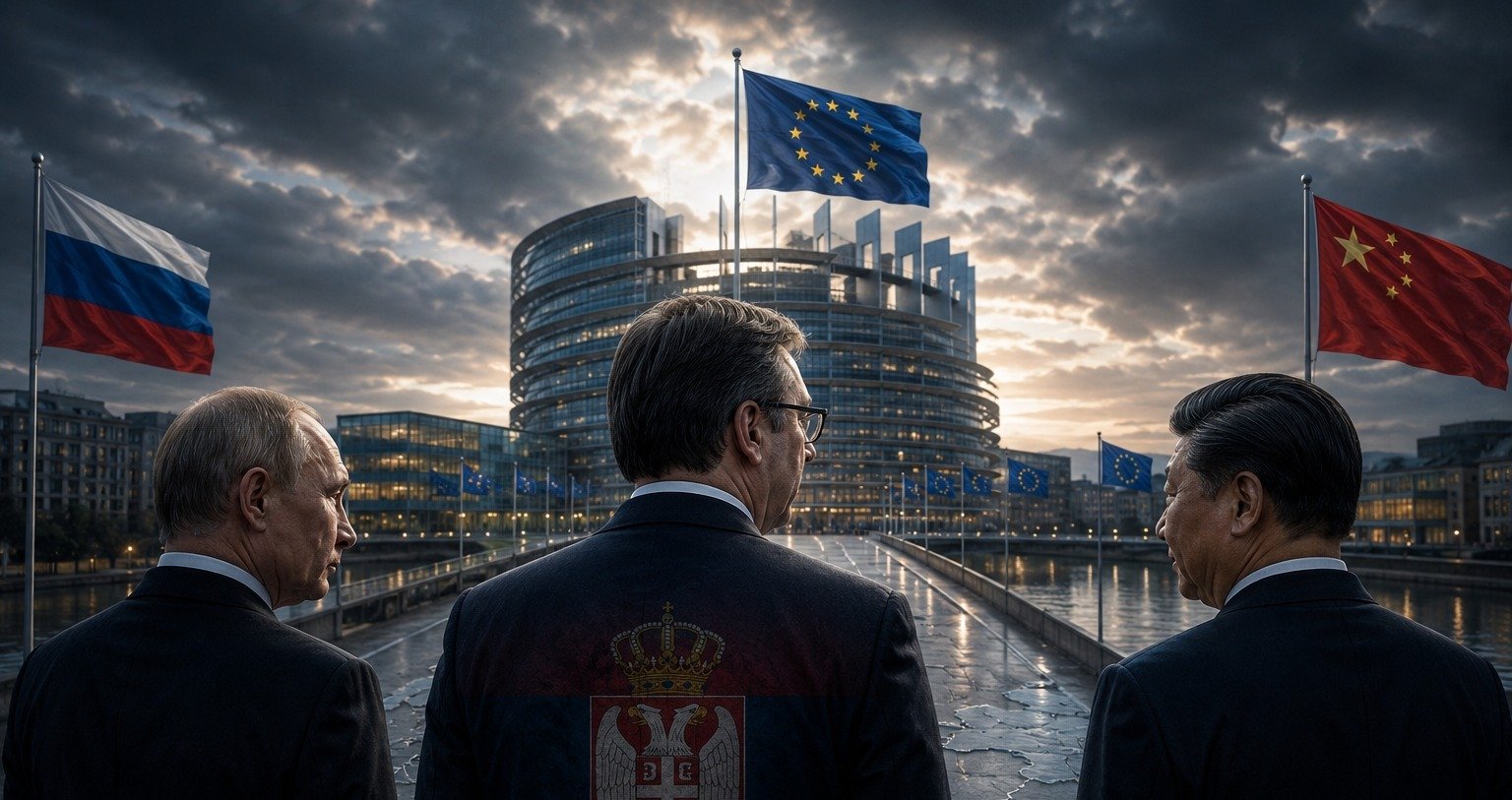
Caught between its energy dependence on Russia and growing Chinese investments, Serbia seeks to maintain a delicate geopolitical balance in an era of profound international realignments. For the European Union, this dual-track approach presents a fundamental dilemma: how can a state that continues to cultivate close ties with Eastern powers while simultaneously declaring its strategic orientation toward the European Union?
Serbia’s case exposes the EU’s own strategic ambiguities and the lack of a coherent vision regarding the political and geopolitical boundaries of Europe. At the very heart of the continent, geopolitical ‘’grey zones’’ continue to persist, spaces that Brussels has often approached with hesitation or insufficient attention. Among them stands Serbia, a long-standing EU candidate whose political and strategic loyalties increasingly lean toward the East. In this context, Serbia has frequently been portrayed as a potential “Trojan horse,” offering fertile ground for Russian and Chinese influence to expand and consolidate. Through economic leverage, political partnerships, and strategic engagement, Moscow and Beijing have been able to strengthen their presence while simultaneously testing the cohesion and credibility of a Europe that often appears uncertain and fragmented in its approach toward the Western Balkans.
For President Aleksandar Vučić, Russia remains an important political and strategic partner in Serbia’s foreign policy (Reuteurs, 30/03/2026). In Serbian society, Moscow is widely perceived as a historical ally, not only due to political ties but also because of cultural, religious, and Slavic affinities that have built a sense of traditional solidarity over time. This special relationship significantly influences Serbia’s diplomatic orientation (Patalakh, 2018:505). Belgrade’s refusal to align with European Union sanctions against Russia following the war in Ukraine has deepened the perception of a strategically ambiguous position, further complicating Serbia’s full rapprochement with Euro-Atlantic structures and gradually isolating it from European partners (EUCFR, 2022). Serbia represents perhaps the clearest example of this persistent and contradictory balancing policy. While officially committed to European integration, Belgrade continues to preserve close political and strategic ties with Russia alongside an expanding economic partnership with China. For Brussels, this creates an increasingly uncomfortable paradox: Serbia remains a key actor for maintaining stability in the Western Balkans, yet its strategic orientation and foreign policy choices are drifting further away from the principles and priorities of the European Union.
Serbia between the European Union and Russia
The European Union considers Serbia a strategically important candidate country, while being fully aware of the challenges posed by enlargement toward a state where Russian and Chinese influence is increasingly visible. The lack of full alignment with EU foreign policy, combined with growing economic dependence on external actors, significantly limits the country’s real progress toward accession (European Commission, 2024:95). The EU has clearly defined its conditions, including strengthening democratic institutions, increasing governmental transparency, and ensuring the rule of law. However, Serbia’s implementation of these criteria has remained limited and lacking meaningful progress, creating the impression of insufficient political will to advance the European agenda. Meanwhile, the European Union continues to adopt a cautious approach in order not to push Serbia further toward Eastern alignment. However, this hesitation has created a strategic vacuum that is effectively exploited by Russia and China. In practice, Serbia has not formally abandoned the European project, but is pursuing a calculated balancing policy aimed at maintaining a more flexible relationship tailored to its own interests, without strong political or normative constraints (Bechev, 2017:12–14). Nevertheless, in the current international context of growing geopolitical polarization, this approach is becoming increasingly difficult to sustain. Serbia’s balancing policy is evolving into a form of multi-layered dependency: energy dependence on Russia, economic dependence on China, and political dependence on the European Union. In this sense, Serbia represents a typical case of European ambiguity: a country close enough, yet not sufficiently aligned to be fully integrated. This situation also reflects the EU’s own strategic ambiguity regarding its future enlargement policy (Mujanovic, 2018:5–8).
Since obtaining candidate status in 2012, Serbia has consistently declared EU integration as its primary strategic priority. The EU remains Serbia’s largest economic partner, main investor, and largest financial donor. However, Serbia has refused to fully align its foreign policy with that of the EU, particularly regarding sanctions against Russia following the invasion of Ukraine (European Commission, 2024:96). Despite Serbia’s ambiguous stance toward both the EU and Russia, Western responses have remained relatively moderate and largely limited to political statements and periodic reports, without strong punitive measures. This lack of direct pressure raises the question of why the EU and its allies have not imposed stronger sanctions on Belgrade for its persistent non-alignment with European foreign policy.
One of the main reasons is Serbia’s strategic importance in the Western Balkans. As an EU candidate country, Serbia is considered crucial for regional stability. Brussels fears that overly punitive measures could have the opposite effect, pushing Belgrade closer to Russia and China. This logic of “stability over confrontation” has led the EU to prefer a cautious, non-punitive approach, even when its standards are not fully respected. Another factor is mutual economic and political interdependence. The European Union is Serbia’s main trading partner and largest source of foreign investment, while Serbia represents an important geopolitical node in a sensitive region for the EU. This interdependence limits the scope for sanctions, as escalation would also entail costs for the EU itself. According to Florian Bieber, this form of external support for regimes that prioritize stability over democratic reform constitutes what he calls “stabilitocracy” (Bieber, 2018:338–339). In this context, the absence of sanctions is not merely political tolerance, but also a deliberate strategy of “engagement without strict conditionality.” This approach aims to keep Serbia within the European orbit, even if it does not fully align with EU foreign policy. However, this strategy has been widely criticized by scholars, who argue that it creates space for “dual exploitation” by external actors such as Russia and China, without real costs for Belgrade (Bechev, 2017:245-247).
On the other hand, Serbia has successfully exploited this diplomatic space. By not fully aligning with EU sanctions against Russia after the war in Ukraine, Belgrade has maintained favorable relations with Moscow while “continuing” the European integration process, albeit without clear progress. This dual policy, often justified as “strategic neutrality,” in practice functions as a mechanism for maximizing benefits from both sides without incurring clear political costs. This situation has generated significant criticism of the European Union itself, which is perceived as ambiguous and indecisive in its enlargement policy. The lack of a strong punitive line against Serbia undermines the credibility of EU foreign policy and creates the perception that EU standards are applied selectively. As Dimitar Bechev argues in Rival Power: Russia in Southeast Europe, this kind of Western strategic ambiguity allows regional actors to pursue hybrid policies without significant consequences (Bechev, 2017:245–247).
Strategic Ambiguity as a Political Instrument
Serbia’s “neutrality” cannot be equated with classical models such as Switzerland or Austria, as it functions more as a political and strategic tool in service of national interests, particularly regarding non-recognition of Kosovo and Serbia’s reliance on Russian support in the international arena. As Jović & Lazić (2026) argue, this “strategic ambiguity” is not merely a product of external circumstances but has become a deliberate governing strategy that allows Serbia to maintain political flexibility and benefit economically from multiple international actors without fully committing to a single bloc (Jović&Lazić, 2026 :79-80). This ambiguity is not only the result of domestic political inconsistency, but a purposeful instrument enabling Serbia to simultaneously pursue contradictory objectives: non-recognition of Kosovo’s independence, continuation of EU integration, and preservation of support from allies such as Russia and China.
This strategy has allowed Serbia to maintain a relatively favorable position in the international arena, avoiding isolation from the West despite its confrontational approach toward Kosovo, including direct interference through support for parallel political structures and paramilitary groups, particularly in northern Kosovo, thereby undermining institutional sovereignty and stability. As Florian Bieber (2015) argues, Serbia’s policy toward Kosovo is often characterized by a “balancing between external pressure and internal nationalist narratives,” where the issue of Kosovo’s sovereignty remains central to domestic political legitimacy (Bieber, 2015:309–312). Meanwhile, the European Union has adopted an approach based on dialogue and ‘’soft conditionality’’, linking Serbia’s EU path to normalization of relations with Kosovo. However, the absence of strong enforcement mechanisms has resulted in slow and often stalled progress due to divergent interpretations of agreements. In this context, Serbia’s strategic ambiguity functions as a deliberate tool for managing a frozen conflict, allowing Belgrade to maintain its non-recognition stance while avoiding significant political costs in relations with the EU. This hostile approach toward Kosovo, combined with the lack of EU punitive measures, has contributed to persistent climate of tensions in the Western Balkans, where full normalization of relations between two countries remains unclear. Serbia’s strategic ambiguity toward Kosovo does not represent a temporary condition, but rather an institutionalized element of Serbian foreign policy. It reflects the persistent tension between international pressures for the normalization of relations and the domestic need to preserve nationalist narratives and claims of sovereignty. In this context, the Brussels Dialogue remains an important diplomatic instrument; however, it is still insufficient to produce a comprehensive and sustainable solution capable of ensuring long-term peace and stability in the region.