

Today, 37 years ago, Slobodan Milošević had “formalized” the plan for the Serbianization of Kosovo. The suppression of autonomy on March 23, 1989 was preconditioned through “victimization” as a strategy of the Academy of Sciences (1986), in order to legitimize violence as a “defensive” instrument. The level of political autonomy guaranteed by the 1974 Constitution was the legal obstacle to Milošević’s mechanism: first, the narrative of “victimization” (Kosovo Polje, 1987) and its use to justify the suppression (The Guardian, 2019), so that extraordinary measures would encourage the emigration of Albanians (Human Rights Watch, 1990–1992) as a method for the gradual realization of ethnic cleansing.
Dismissals from workplaces, violent measures in education, media, administration, and policing preceded a regime of fear and subjugation, calculating the eventual extinguishing of resistance.
However, the constitutional premise of total control and imposed stability, as in Vojvodina, was translated in Kosovo into civic mobilization. Protests and the parallel organization of the “Republic of Kosovo” following the July 2 declaration and the Kaçanik Constitution of September 7, 1990 were responses of peaceful resistance by Albanians, which over time proved insufficient in the face of Milošević’s criminal apparatus.
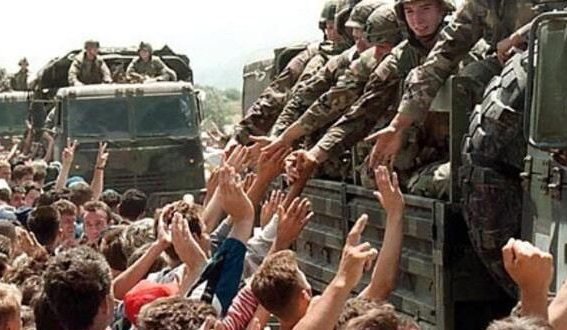
Meanwhile, the organization of armed resistance through the Kosovo Liberation Army became a decisive factor that made the Serbianization project impossible, demonstrating to the world an unwavering determination on the path to freedom (the KLA’s Epopee). Despite challenging conditions and organization, the sacrifice of KLA fighters compelled international intervention (NATO, 1999) against Serbia’s genocidal project.
The final objective of Milošević’s project following the suppression of autonomy was brutally exposed in 1999 through Operation Horseshoe (Under Orders: War Crimes in Kosovo, 2001). Terror, killings, massacres, sexual violence, and the forced deportation of over 900,000 Albanians to Albania and North Macedonia have been widely documented as a campaign organized by the highest levels of the Serbian–Yugoslav leadership for the ethnic cleansing of Kosovo.
The international intervention, after failed diplomatic efforts, dismantled the Serbian military and police machinery, but its political strategy revived “victimization” under new circumstances. After the military defeat in 1999, Serbia continued hybrid aggression, refining propaganda and mobilizing criminal structures to undermine Kosovo. The March 2004 unrest was used as a strategic turning point, fabricating a narrative of “pogrom victimhood.” Since then, the strategy has been refined through propaganda aggression (disinformation campaigns, misleading narratives about “discrimination and terror against Serbs”), the instrumentalization of the Serb community, and the use of the Brussels dialogue as an international platform against the Republic of Kosovo.
Thus, March 23, 1989 remains a constitutional premise that failed with Milošević, but which continues to pose a threat today through the hybrid strategies of Vučić.