

Gjon Culaj, Associate Fellow at the “Octopus” Institute
Security constitutes one of the fundamental concepts of international relations, especially in regions where the history of conflicts and the lack of trust among actors continue to shape political and security developments. The Western Balkans represent a characteristic example of such an environment, where security dynamics cannot be understood without analyzing the complex interaction between historical, political, and military factors. In this context, the increase of Serbia’s military capacities in recent years has sparked broad discussions regarding regional stability and its impact on interstate relations.
Instrumentalization of the ‘security dilemma’
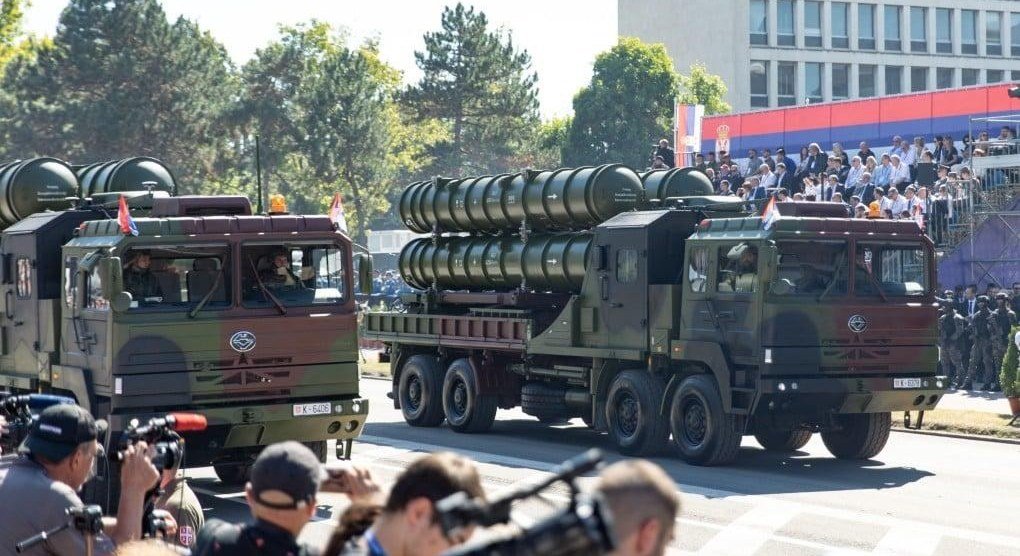
To understand this phenomenon, it is essential to consider the theoretical framework of the “security dilemma.” According to Robert Jervis, measures that a state undertakes to strengthen its own security often end up increasing systemic insecurity rather than reducing risk (Jervis, 1978:169–170). In this context, Serbia’s militarization cannot be treated merely as an ordinary process of military modernization or as a necessity for defense and security, but rather as part of a more complex strategic and political interaction taking place in the Western Balkans, particularly in relation to Kosovo. Serbia’s extensive militarization, accompanied by nationalist rhetoric, is considered a threat to a region still burdened by unresolved conflicts. Serbia has deepened its defense cooperation with Russia and China through significant arms acquisitions (Reuters, 13/03/2026), investing heavily in air power, missile systems, and sophisticated military technologies. This military expansion has contributed to a shifting security environment in the region, with important implications for Kosovo, particularly amid the renewed geopolitical confrontation between the West and Russia following the Russian invasion of Ukraine.
Within Serbian propaganda discourse, these investments are portrayed as indispensable for safeguarding territorial integrity and consolidating the state’s strategic position in response to a perceived ‘strategic encirclement,’ particularly in light of the alleged threat posed by a trilateral alignment between Kosovo, Albania, and Croatia. Serbian President Aleksandar Vučić has repeatedly declared that Serbia must possess a “strong army” in order to “guarantee peace and stability“ (Government of Serbia, 2024). However, in the context of relations with Kosovo, such statements are perceived as threatening and destabilizing, given their connection to a sensitive history of armed conflict and a relationship that remains not yet normalized. Taking into account the lack of mutual recognition, as well as repeated episodes of Serbian interference, these statements in Kosovo are interpreted as part of a broader political discourse associated with a more aggressive approach toward Kosovo. They are also frequently associated with alleged support for paramilitary groups engaged in activities perceived as undermining stability within the country, particularly in sensitive areas such as northern Kosovo. In this context, Serbia’s objectives and its destabilizing strategy continue to keep the region in a persistent state of fragility and unstable equilibrium, thereby hindering the long-term consolidation of peace and security.
Kosovo facing Serbia’s military build-up
Kosovo views Serbia’s growing military capabilities as a significant threat to its national security. This concern stems not only from the legacy of the (1998–1999) armed conflict, but also from Serbia’s continued refusal to recognize Kosovo’s independence and its recurrent use of political rhetoric and destabilizing actions aimed at undermining Kosovo’s sovereignty and institutional authority. The continued militarization of Serbia cannot be viewed separately from its concrete actions on the ground and its overall approach toward Kosovo. The security dilemma in the region becomes even more challenging when military strengthening is accompanied by destabilizing actions in northern Kosovo, including violent and terrorist acts aimed at creating insecurity and continuous tensions. These developments are by no means isolated. They are fully synchronized with ongoing efforts to portray Kosovo as a failed state, whether through campaigns against international recognitions or attempts to block its participation in international organizations.
In this sense, Serbia’s military build-up cannot be interpreted merely as a defensive measure, but rather as part of a broader strategy that combines political, diplomatic, and security pressure. Consequently, Kosovo, as a factor of peace in the region, finds itself in a position where strong security guarantees become both urgent and indispensable. In this regard, Kosovo’s membership in NATO, as soon as possible, although not an easy process, must remain our strategic priority. Membership in this alliance would considerably limit opportunities for destabilization while simultaneously reinforcing the country’s international standing.
In an increasingly fragmented and unpredictable international environment, peace and security cannot be taken for granted, they must be continuously safeguarded and reinforced. In this context, strengthening defense capabilities and advancing toward NATO integration should represent Kosovo’s strategic response to regional security challenges posed by Serbia. Moreover, the recurring tensions and armed incidents in northern Kosovo have reinforced concerns that Serbia could employ its military power as a tool of political leverage and strategic pressure. The terrorist attack in Banjska (September 2023) was rightly considered by Kosovo authorities as evidence of the connection between Serbian paramilitary structures and Serbia’s destabilizing policies toward Kosovo. The conviction of the terrorists responsible for the Banjska attack constitutes strong evidence that democracy and the rule of law triumph over violence and terrorism. Some of the perpetrators were found guilty and sentenced to life imprisonment and long-term imprisonment for this terrorist act (Koha Ditore, 24/04/2026). This decision of Kosovo’s judiciary is valuable proof that any attempt to undermine the values of freedom and the constitutional order will face justice, sending a clear message that the rule of law remains stronger than terrorism and is the guarantor of the country’s security and stability.
The Serbia–Russia Axis in the New Regional Geopolitics
An important element in the analysis of Serbia’s militarization is Russian influence in the region. Russia has used Serbia as a strategic ally in the Balkans in order to preserve its political and military influence. According to Stronski and Himes, Moscow exploits military cooperation with Serbia to hinder the Euro-Atlantic integration of the Western Balkans (Stronski&Himes, 2019:6). Russian support for Serbia regarding the Kosovo issue has further strengthened the strategic dimension of militarization. Russia opposes Kosovo’s independence and uses the Kosovo issue as a precedent in its foreign policy. For this reason, military cooperation between Serbia and Russia is seen by Kosovo and the West as part of a broader geopolitical strategy. Furthermore, China’s involvement in Serbia’s military supply demonstrates that Belgrade is diversifying its strategic partners, creating a new balance of influence in the Balkans (QKSS, 2024:5).
Russia’s aggression against Ukraine in 2022 fundamentally changed the architecture of European security and significantly increased the strategic importance of the Western Balkans. This development has revived great-power competition in Europe and increased attention toward regions considered “sensitive geopolitical spaces,” including the Balkans. In this new context, relations between Serbia and Russia acquire an even more strategic dimension. According to analyses by the European Union Institute for Security Studies, following the war in Ukraine, Russia intensified the use of regional partners in order to preserve its influence in Southeastern Europe and challenge NATO and EU enlargement (EUISS, 2023). In this framework, Serbia continues to maintain close political and military ties with Russia, including cooperation in the fields of energy, security, and defense. After 2022, due to the war in Ukraine and the broad sanctions imposed by the European Union and Western allies against Russia, international relations have been characterized by increased political and diplomatic polarization. In this context, Serbia, although a candidate country for EU integration, did not join the EU sanctions against Russia and continued its relations with Moscow, distinguishing itself from the majority of European states. Another important element is the use of political and informational narratives. Russia has intensified disinformation campaigns in the Balkans following the war in Ukraine, with the aim of weakening trust in Euro-Atlantic institutions and creating political divisions within the countries of the region.
This new situation has direct implications for Kosovo’s security. Following the war in Ukraine, NATO increased its presence in Eastern and Southeastern Europe, considering the Balkans an important space for the stability of the Alliance’s southern flank. According to NATO, the security of the Western Balkans is closely linked to efforts aimed at countering and preventing the destabilizing influence of external actors in the region (NATO, 2022). Within this context, Serbia’s military buildup and its cooperation with Russia and China are interpreted as elements of a wider strategy aimed at maintaining international balance and diversifying strategic partnerships. Nikolaos Tzifakis and Eleni Vasdoka emphasize that Serbia is pursuing a “multi-vector policy,” maintaining relations with both East and West in order to maximize strategic flexibility (Tzifakis & Vasdoka 2025:301).
On the other hand, the European Union faces considerable challenges in consolidating its geopolitical influence in the region. The war in Ukraine has strengthened discourse regarding European strategic autonomy, but the lack of complete unity among member states continues to limit the EU’s ability to act as a unified security actor. Through the Common Security and Defence Policy and the enlargement agenda, the EU aims to promote stability in the region; however, this effort is complicated by competition from other geopolitical actors and the ongoing need for internal institutional and structural reforms (Biscop, 2022:45).
This analysis shows that Serbia’s armament cannot be viewed simply as a technical process of military modernization, but is closely connected to its broader political and diplomatic strategy toward Kosovo, as well as its regional ambitions. This includes efforts to preserve political influence in northern Kosovo as well as the use of international instruments to challenge the consolidation of Kosovo’s statehood. In this context, the role of international actors such as NATO and the European Union remains decisive for maintaining stability. NATO’s presence through KFOR has been a key factor for peace, while the EU struggles to manage tensions through dialogue and the European integration process.
However, recent geopolitical developments, including the growing influence of Russia and China in the region and the polarization following the war in Ukraine, have increased the complexity of security in the Balkans. This makes it more difficult to build a sustainable balance and increases the importance of strategic alliances for Kosovo. In this sense, the response to security challenges cannot be one-dimensional. Responding effectively to these security challenges requires an integrated approach that includes strengthening national defense capacities, consolidating state institutions, and advancing Euro-Atlantic integration, especially through closer alignment with NATO. Such a balanced strategy is essential for reducing the likelihood of escalation, protecting national security, and fostering long-term regional stability.