

Gjon Culaj, Associate Fellow at the “Octopus” Institute
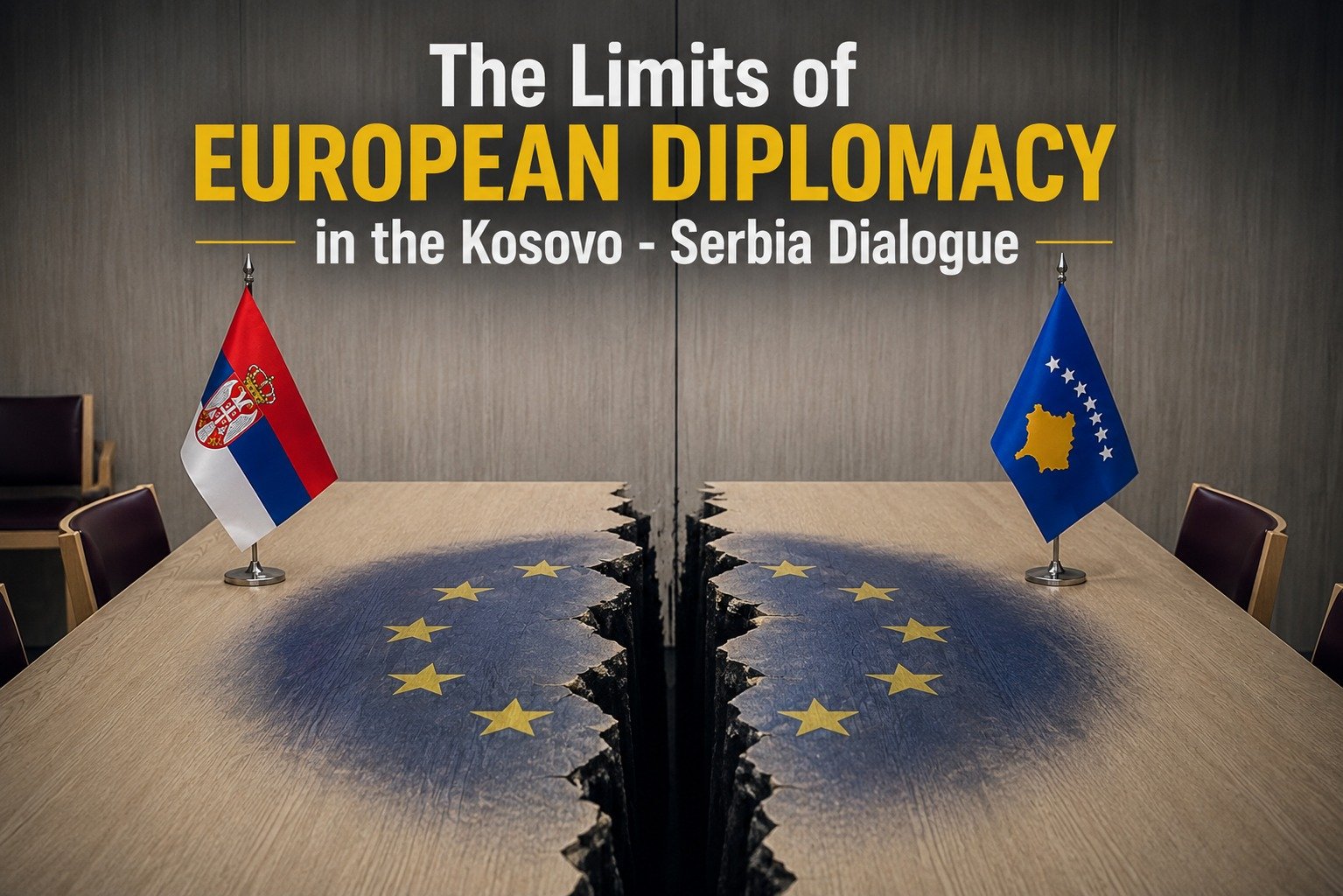
Since the launch of the European Union-facilitated dialogue in 2011, expectations were that the process would become the primary mechanism for the normalization of relations between Kosovo and Serbia and for the consolidation of peace and stability in the Western Balkans. However, after more than 15 years of effort, the dialogue has produced several agreements but very few tangible results on the ground. This demonstrates the limitations of European diplomacy as a mediator and, at the same time, exposes Serbia’s strategy of using the dialogue not as an instrument of reconciliation, but rather as a mechanism for preserving the status quo and obstructing the international consolidation of Kosovo’s statehood.
The impotence of “neutral diplomacy”
Since the emergence of the European integration project, the European Union has sought to present itself as a global actor committed to peace, stability, and conflict resolution. Nevertheless, the history of the Western Balkans has revealed significant limitations in the EU’s diplomatic capacities. The Kosovo-Serbia dialogue, facilitated by the European Union, represents one of the clearest examples of the challenges and shortcomings of European diplomacy in producing sustainable political agreements.
In the field of international relations, the European Union is often described as an actor that exercises influence primarily through normative power rather than through traditional military instruments. According to Ian Manners, the EU’s international identity is based on its ability to promote and diffuse universal norms such as democracy, the rule of law, human rights, and multilateralism, shaping the behavior of other actors through normative legitimacy rather than coercion (Manners, 2002:243). Similarly, François Duchêne characterized the European Community as a “civilian power” that relies on diplomacy, economic integration, and political instruments instead of military force (Duchêne, 1972). This concept was further developed by Jan Orbie (2006), who considers “civilian power“ a central component of the EU’s international identity, distinguishing it from traditional state actors that primarily rely on military and coercive instruments (Orbie, 2006:124-125).
However, according to Niklas Helwig, the EU’s ability and capacity to project and enforce these norms internationally have frequently been questioned due to the lack of political consensus among member states and institutional constraints that have significantly reduced the Union’s capacity to translate its economic and normative influence into concrete foreign policy outcomes (Helwig, 2023:59-60). According to Nathalie Tocci (2021), the EU’s ambition to act as a geopolitical actor is often constrained by structural limitations arising from the absence of strategic unity among member states and the Union’s continued dependence on transatlantic partners in security matters (Tocci, 2021:9-10). Similarly, Sven Biscop (2021) contends that security challenges in Europe’s neighborhood have exposed the gap between the European Union’s political ambitions and its capacity to act autonomously (Biscop, 2021:3).
These debates are closely linked to Christopher Hill’s (1993) concept of the “capability–expectations gap,” which argues that the European Union lacks the political and institutional capacities necessary to act effectively as a global actor (Hill, 1993:305-306). This thesis remains highly relevant today. According to Niklas Helwig (2023), despite the institutional development of the Common Foreign and Security Policy, the European Union continues to struggle to transform its economic and normative power into political influence during international crises and conflicts (Helwig, 2021:59). This contradiction becomes particularly evident in prolonged conflicts and territorial disputes, where EU diplomacy has faced considerable challenges of achieving sustainable political settlements.
In this context, the Western Balkans, and particularly the Kosovo-Serbia dialogue, represent a crucial test of the European Union’s international credibility. Although the EU has been the principal mediator in the process of normalizing relations between the two countries, the limited outcomes of the dialogue have raised important questions regarding its ability to exercise transformative influence in complex security environments and to act as a guarantor of sustainable peace in the region (Dopchie, 2022:20-21). This perspective is particularly important for understanding the EU’s role and influence in the Western Balkans. The region has long been regarded as a critical test of European foreign policy credibility, given its geographical proximity to the Union and its geopolitical importance as well as the fact that the EU has invested considerable political, economic, and institutional resources in promoting peace, stability, and democratic transformation of the region.
The Western Balkans: A Challenge for European Foreign Policy
The limitations of European diplomacy became apparent during the violent disintegration of the former Yugoslavia. Throughout the wars in Croatia and Bosnia and Herzegovina in the 1990s, the European Community, and later the European Union, proved unable to prevent armed conflict or impose an effective political settlement. It was only after the direct engagement of the United States and NATO’s military intervention that the conditions were created for the conclusion of the Dayton Peace Agreement in 1995. The Kosovo war of 1998–1999 further highlighted the limitations of European diplomacy to resolve the crisis through negotiation, while NATO’s military intervention, under U.S. leadership, became the decisive factor in ending the conflict.Even in the period following Kosovo’s declaration of independence, the EU-led dialogue produced a significant number of technical agreements but failed to achieve its principal objective: the full normalization of relations and mutual recognition between Kosovo and Serbia. Many of the agreements reached have either remained unimplemented or have been interpreted differently by the parties. This has raised serious questions regarding the European Union’s ability and capacity to ensure compliance with the commitments that it has itself mediated (Medovic, 2022:10).
One of the principal criticisms of the EU’s approach lies in the absence of effective enforcement mechanisms. In contrast to the United States , which combines diplomatic pressure with substantial political, economic, and military leverage, the European Union remains largely dependent on normative influence and enlargement-related conditionality as its primary sources of influence. As the enlargement process has slowed and the credibility of the membership perspective has diminished, the EU’s influence over regional actors has weakened considerably. Consequently, the room for success has been increasingly limited. Recent developments have strengthened the argument that significant progress in the dialogue has often occurred only when the United States has been directly involved. The Washington Agreement of 2020, as well as subsequent American support for normalization efforts, demonstrated that transatlantic engagement remains a crucial factor in encouraging compromise and overcoming persistent deadlocks in the negotiations. Likewise, the Basic Agreement of 2023 was strongly supported by transatlantic coordination, highlighting that American political and strategic support remains crucial factor in strengthening the European Union’s efforts to preserve peace and stability in the Western Balkans (Maliqi, 2023:9-11).
Kosovo–Serbia Normalization: The EU’s Strategic Test
Since the initiation of the EU-led dialogue in 2011, expectations were that the process would ultimately lead to the normalization of relations between Kosovo and Serbia. However, after more than fifteen years of negotiations, the dialogue has produced several agreements but very limited progress in terms of their practical implementation (European Commission, 2023:79-80). This reflects the limitations of EU in its role as a mediator, while simultaneously highlighting Serbia’s strategic approach of using the dialogue not primarly as a instrument for reconciliation and sustainable political settlement, but rather as a mechanism for preserving the status quo and obstructing the international consolidation of Kosovo’s statehood.
One of the most persistent criticisms of the European Union’s approach has been its emphasis on procedural neutrality, even in circumstances where one party has systematically violated agreements or deliberately generated tensions. While impartiality represents a fundamental principle of mediation, such impartiality should not be interpreted as an equal attribution of responsibility when the behavior and commitments of the parties differs fundamentally (Gashi, Musliu, & Orbie, 2017:534 -535). Serbia has persistently challenged Kosovo’s statehood, finance parallel structures in northern Kosovo, conduct diplomatic campaigns against Kosovo’s international recognition, and employ nationalist rhetoric for domestic political purposes. Despite these actions, the EU’s response has largely remained declaratory, without significant political or economic consequences. As a result, a perception has emerged that failure to comply with negotiated commitments does not generate any political costs for Belgrade.
Serbia has consistently pursued a strategy that may be described as “negotiation without the intention of reaching a final settlement,” whereby the dialogue process is used to gain time, preserve European political and financial support, and simultaneously continue its policy of non-recognition of Kosovo. This approach has been reflected in selective implementation of agreements, unilateral interpretations of obligations, and the recurrent emergence of security crises that repeatedly return the dialogue to its starting point. As a result, the dialogue has gradually evolved from a process of normalization into a mechanism for crisis management. A significant illustration of these limitations is the 2023 Ohrid Agreement, which was widely presented as a major step toward in the normalization process. Although promoted by the European Union as a key achievement, the absence of binding implementation mechanisms combined with Serbia’s refusal to formally endorse the agreement through signature have significantly undermined its effectiveness. Even two years of its adoption, most of its provisions remain unimplemented, demonstrates the gap between diplomatic achievement and practical outcomes, revealing that EU mediation has often been more effective in facilitating political commitments than in ensuring enforcement instruments or imposing tangible costs on parties that fail to fulfill their commitments (Stanicek, 2025:4-5).
From the regional security perspective, Serbia’s role remains one of the key challenges to achieving sustainable peace in the Western Balkans. Belgrade has been associated with a model of “stabilocracy” (Bieber, 2018:338–339), presenting itself to the European Union as a central pillar of regional stability, while simultaneously maintaining influence over the Serbian community in Kosovo and using tensions as a negotiating instrument. The sustained financial and institutional support of parallel structures in northern Kosovo, the absence of a clear and consistent condemnation of individuals associated with violent and terrorist acts, as well as the ongoing rejection of Kosovo’s sovereignty, represent major obstacles to the advancement of a sustainable normalization process between Kosovo and Serbia
Serbia has consistently approached the dialogue as a tool for advancing and safeguarding its strategic interests, combining formal participation in negotiations with actions that have undermined stability. This approach appears less oriented toward achieving genuine normalization and more toward maintaining a low-intensity conflict that can be activated or intensified whenever it serves Belgrade’s political objectives. As long as such dynamics persist, the Kosovo – Serbia dialogue will remain less a process of conflict resolution and more a mechanism for managing recurring instability, thereby exposing the limitations of the European Union’s diplomatic and strategic effectiveness in Western Balkans.