

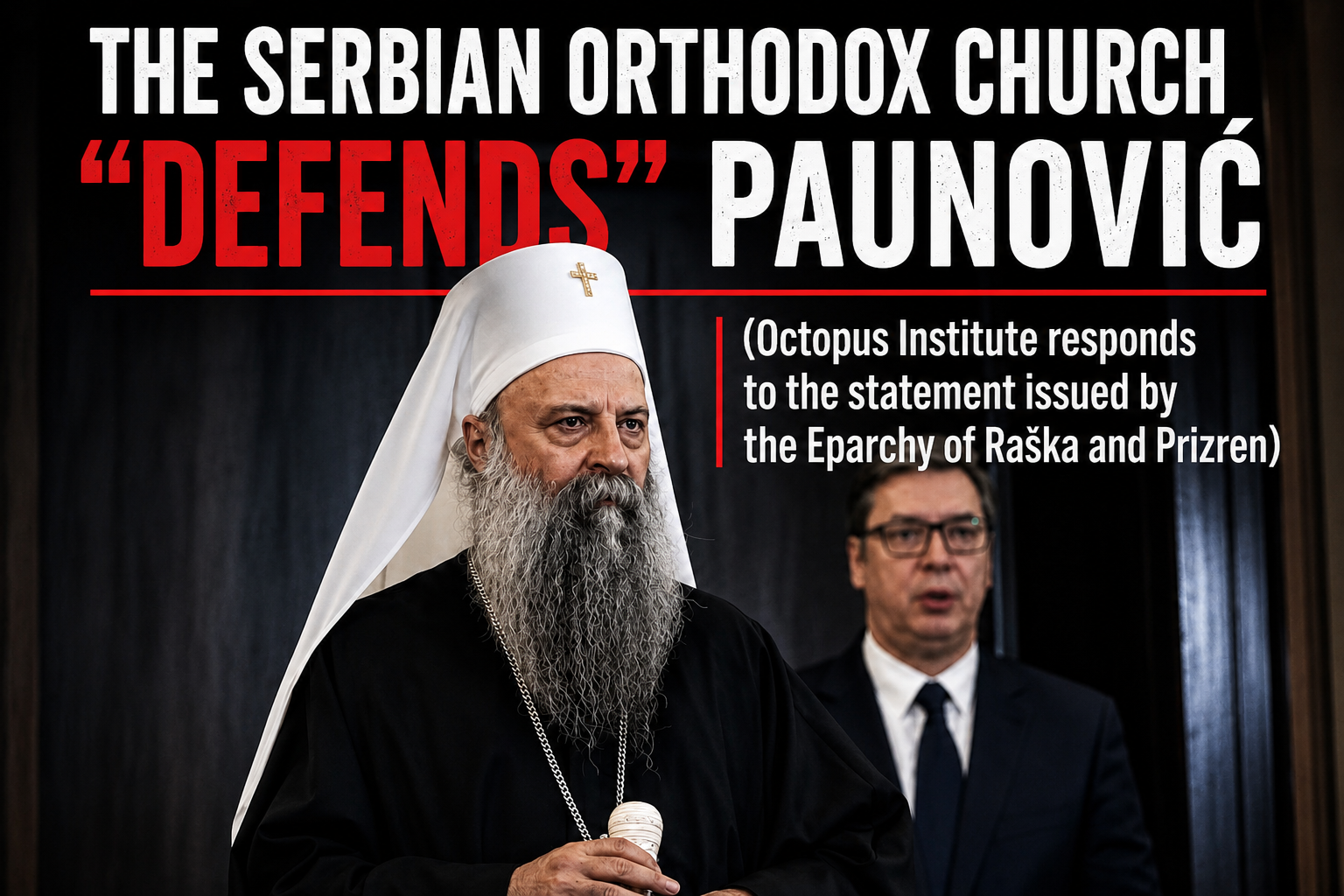
The Institute for Hybrid Warfare Studies “Octopus” assesses the statement issued by the Eparchy of Raska and Prizren as a compilation of Serbia’s manipulative narratives, which implicitly defends Minister Paunović.
Following strong international reactions to the minister’s statement on the “ethnic cleansing of Kosovo,” the Eparchy seeks to divert attention from Belgrade’s political responsibility by repeating victimization narratives about the alleged “discrimination, oppression, and terror” against Serbs in Kosovo.
In the context of strategic communication, this represents a well-known model of information crisis management, whereby the narrative is transferred to the Church as a religious institution endowed with moral authority and symbolic influence.
The statement, entitled “The Increasingly Difficult Position of the Serbian People and the Church in Kosovo and Metohija,“ employs language that goes beyond concerns for religious rights, reiterating the narrative that Serbs in Kosovo are allegedly facing “complete disappearance.”
Such wording, charged with political and psychological implications, is intended not only to manipulate international public opinion but also to justify Paunovic’s statement by portraying a situation analogous to ethnic cleansing.
The Serbian Orthodox Church, which only a few days ago awarded the Order of Saint Sava to Danica Marinkovic—known for denying the Racak massacre and for defending the legality of war crimes committed in Kosovo—has now positioned itself as a mitigating actor against international pressure by rehabilitating Milošević’s legacy and legitimizing the objectives of the “Serbian World” project.
This reflects the hegemonic project adapted to the post-war environment, which Serbia seeks to advance through its hybrid strategy by relativizing responsibility for war crimes that have been documented and condemned internationally.
The statement presents no factual evidence that could warrant international investigation or monitoring. Instead, it amplifies political narratives portraying Kosovo’s institutions as a systematic mechanism of discrimination and the Kosovo Police as an instrument of ethnic oppression.
The Octopus Institute considers it particularly alarming that the Serbian Orthodox Church has neither distanced itself from Minister Paunovic’s statement nor from Ivica Dacic’s defense of it. Instead, its allegations of ethnic and religious discrimination are framed within Serbia’s hybrid strategy aimed at undermining Kosovo, including portraying:
- the dismantling of illegal structures as institutional discrimination;
- the integration of parallel education and healthcare systems as a violation of access to rights;
- chauvinistic provocations as an exercise of freedom of expression.
The Church’s claim that, without an immediate international response, the “disappearance of the Serbian people” could occur constitutes a victimization narrative framed in alarmist terms, designed to reverse the roles by portraying Serbs as existential victims.
This technique has been consistently employed to relativize the legacy of Milosevis’s policies and to portray Serbia as the “protector” of a supposedly threatened people.
From the perspective of hybrid warfare, the statement contains clear elements of influence operations, including:
- transferring the narrative from political actors to the Church as a source of moral authority;
- shifting attention away from Minister Paunovic’s statement toward the alleged “discrimination against Serbs”;
- amplifying the perceived threat through terms such as “disappearance,” “systematic pressure,” and “persecution”;
- internationalizing the narrative through appeals to KFOR, the European Union, the United Nations, and other international organizations.
This represents Serbia’s strategic communication model, which uses victimization both as a defensive mechanism against international pressure and as an instrument to redirect that pressure onto the international community itself.
The Octopus Institute recalls that the protection of the rights and cultural heritage of minority communities, including the Serbian Orthodox Church, is guaranteed under the Constitution and laws of the Republic of Kosovo, in coordination with and under the oversight of Kosovo’s international partners.
Therefore, just as they responded to Minister Paunovic’s internationally condemned rhetoric and to the repeated calls on President Vucic to surrender the “hero” Milan Radoicic, the European Union, NATO, and the United States should also take seriously the threat posed by the Serbian Orthodox Church through its glorification of terrorists and its honoring of genocide deniers.
Propaganda must not be allowed to disguise itself as humanitarian concern.
Otherwise, the transformation of a religious statement into a strategic communication message constitutes a serious challenge to the security and stability of the Western Balkans.