
Author: Arben Fetoshi
The wave of protests in several European countries due to economic dissatisfaction, the crisis of representation and distrust in institutions, also has a geopolitical dimension in Albania. The reality in the Balkans, marked by political contestation and the ‘revisionist ambitions’ of the anti-Western axis, calls for a contextual analysis beyond the legitimacy of protests as a revolt against a “corrupt and failed” government.
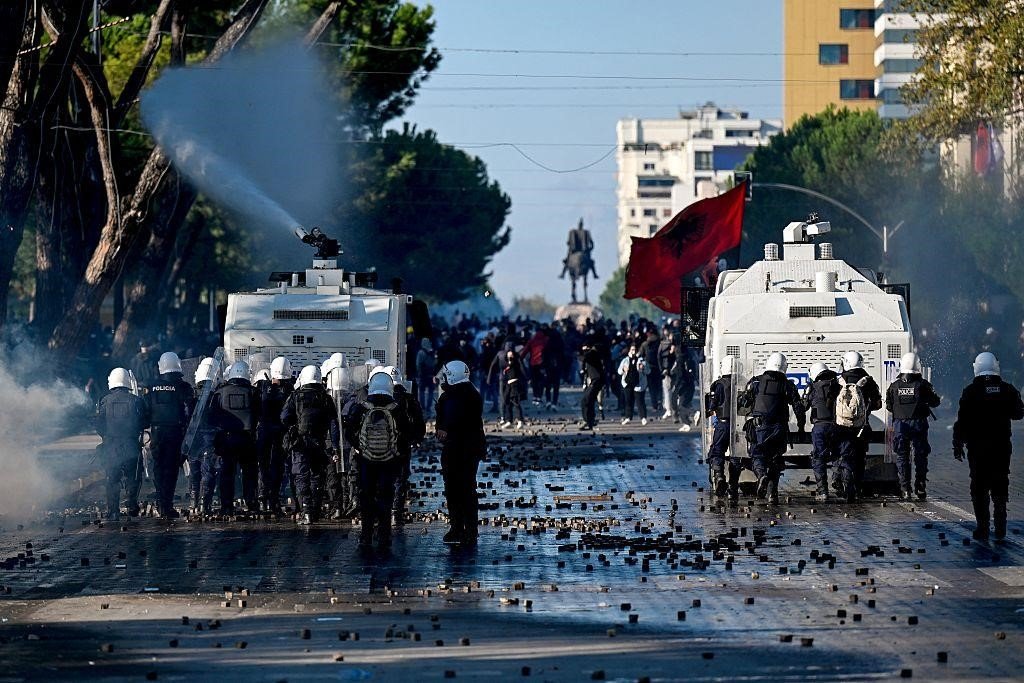
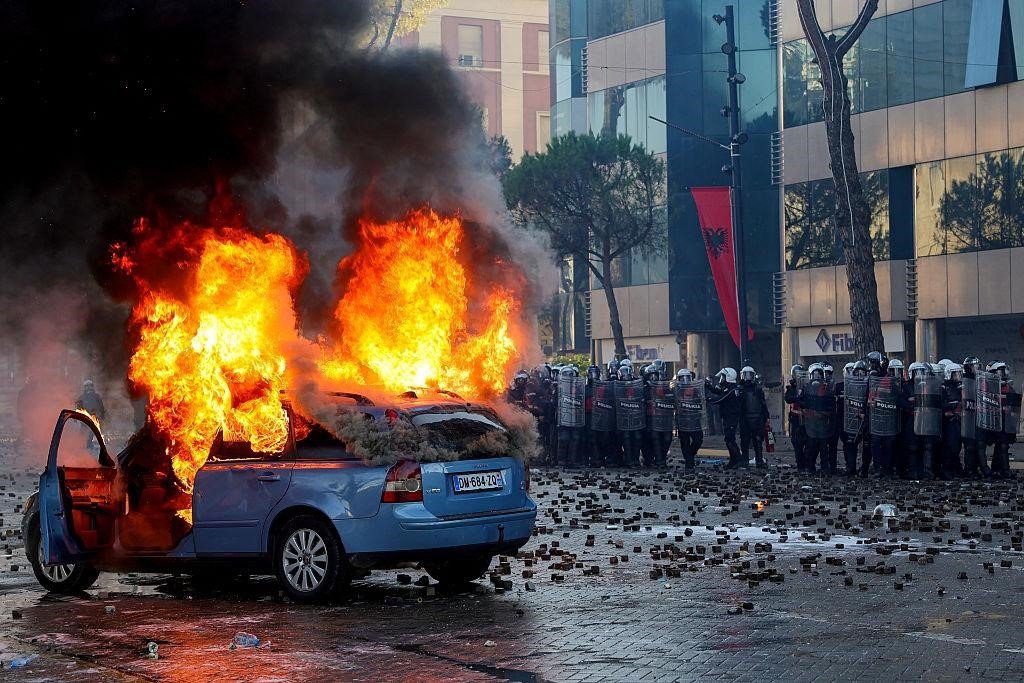
Just a few days after Kosovo, where a ‘political agreement’ prevented snap elections (Reuters, 07.10.2026), and on the very day when Albania took another step forward towards the EU in Luxembourg (European Commission, 13.10.2026), a student rebellion began in Tirana, with fires and Molotov cocktails on one side and water cannons and tear gas on the other. Its characterization as an “awakening” and the call for an Albanian-Serbian front against Europe by ‘Putin’s brain’, Aleksandr Dugin, as well as the framing of Albania as a zone of “war and chaos” by Serbian media, allow for an interpretation that aligns with the anti-Western interests of the axis.
Tirana in flames, whom does it serve?!
The dramatic escalation of protests, with the potential destabilization of Albania, creates circumstances that may favor the strategic interests of Serbia, Russia and China in the Balkans. Beyond legitimate demands and the right to protest, the burning of institutions, destruction of property, use of the KLA flag and unrestrained violence that left people injured on both sides (Reuters, 14.10.2026) cannot be treated merely as authentic dissatisfaction with a “corrupt and failed” government.
Dissatisfaction may be real and the voice of citizens deserves to be heard, but the exploitation of tensions to deepen polarization and undermine trust in the European perspective of a NATO member state, constitutes a threat that must also be examined from the perspective of hybrid warfare.
Serbia’s already proven strategy of sabotaging Kosovo, Moscow’s objectives of undermining the region’s Euro-Atlantic future, and the troubled history of Greek ambitions or Iranian interference in Albania, are premises that must be seriously weighed in the context of current geopolitical shifts (Fetoshi, 2024; Musliu & Elshani, 2024; EU Kosovo Report, 2025). The framing of protests as “chaos and war” in Serbian and Russian media, as well as their association with the “Flamingo Revolution”, namely Jared Kushner’s investment, alongside documented cases of information manipulation, also calls for an investigation into a possible destabilizing agenda.
The question in this case is not whether the protests are legitimate, but whom do the violence, anarchy and destabilization of Albania serve?
It does not matter whether Edi Rama is brought down, but not by bringing down Albania.
Aleksandr Dugin’s “Awakening and Front”
Russian ideologue Aleksandr Dugin, known for his geopolitical revisionism envisioning Russia as the dominant power of Eurasia (Neo-Eurasianism), through the Fourth Political Theory based on tradition, religion and anti-liberalism, provided an answer as to whom the destabilization of Albania serves.
“Albanians are now showing their true colors. This nation was created by Orthodox Christians (the Orthodox priest, Fan Noli) and their Islam is Sufi and mystical. They are Indo-Europeans, by the way. Very interesting and courageous people. They are now awakening,” Dugin wrote on X (17.10.2026). A post of no more than five lines, aimed at the ‘support, identity reframing and anti-Western incitement’ of Albanians, further clarifying the geopolitical background with his call for an Albanian-Serbian front against European globalists” three days later (Dugin, 20.10.2026).
In the context of revisionist interests, the Albanian “awakening” through violence, anarchy and destabilization implies sabotaging Albania’s progress as a NATO member on its path towards the EU. Meanwhile, their identity reframing, by reducing Noli’s multidimensional figure to an Orthodox priest and Albanian Islam to Sufi and mystical, reflects his doctrinal calculation to separate Albanians from Western civilization.
The supporter of Russian aggression in Ukraine, sanctioned by the EU (2022), knows that the truth about Albanian nation-building is different, as is their indigenous presence beyond Albania’s borders: long before Noli, bearing the modern imprint of the National Awakening, based on language, historical memory and cultural heritage, as a result of elites from different religious backgrounds (Szczepanski, 2010). He also knows that the DNA of the Albanian nation is Skanderbeg, born Gjergj Kastrioti, who symbolizes “the common role of the three religions in the unique construction of the Albanian nation” (Ukshin Hoti, Political Philosophy of the Albanian Question, 1996, p. 188). However, the truth runs counter to his project, and therefore history must be revised: in Albania, the opposite of Euro-Atlantic integration (Putinism) is “awakening” – meaning, serving its interests – while Kosovo is Serbia?!
The truth about Milosevic’s terror, violence and genocide does not matter, nor does the fact that scholars argue that the Serbian Orthodox Church appropriated Dardanian-Arbërian heritage (Enver Rexha, 2016; Hysen Ibra, 2024). Kosovo is the “cradle of Serbia” because of the strategic narrative built around the Kosovo myth (Florian Bieber, 2002). Nor does his change of position on the protests in Serbia matter, from describing them as Western instigation of a “color revolution” (Tanjug, 14.03.2025) to declaring Vučić’s political end three months later (Danas, 01.07.2025). What matters is that his change of position preceded their Memorandum on Kosovo (Danas, 17.05.2026), as an “inalienable part of Serbia, the foundation of Serbian identity and a collective obligation to defend it”.
An ideal alignment with his geopolitical revisionism, which, through the “awakening” of Albanians, reveals whom the flames in Tirana serve. On the other hand, when the statement of a protesting student, who said that “they are in contact with colleagues in Serbia regarding forms of organization” (Nacionale, 17.10.2026), is added to his strategic communication, the mosaic becomes clearer, but also more concerning.
The Protests in Serbian-Russian Propaganda
Dugin’s messages, which claim the “failure of the Western model”, are fully aligned with the discourse of Serbian and Russian media regarding the escalation of protests in Albania. Through headlines such as “Tirana Is Burning” and “Violent Protests Shake Albania”, they select the most dramatic images to frame the escalation as a threat to the functioning of the state.
On the other hand, in a report on 17 October, Večernje novosti compared the European response to Albania with the criticism that the EU had directed at Serbia over its treatment of protesters (17.10.2026). Through this article, developments in Albania are used to promote the narrative of Western ‘double standards’. Likewise, the media outlets ‘Politika’ and ‘Kurir’ gave prominence to the statement about contacts between Albanian and Serbian students, presenting it as a political connection.
In this context, Dugin’s message about an Albanian-Serbian front against “European globalists” reveals a tendency towards the ideological framing of “shared dissatisfaction against the West as a common adversary”. For this reason, the discursive exploitation of the escalation in the service of anti-Western interests, at a time when Serbia continued to use Kosovo as an instrument of mobilization during the parliamentary election campaign, represents a hybrid threat that extends beyond its borders.