

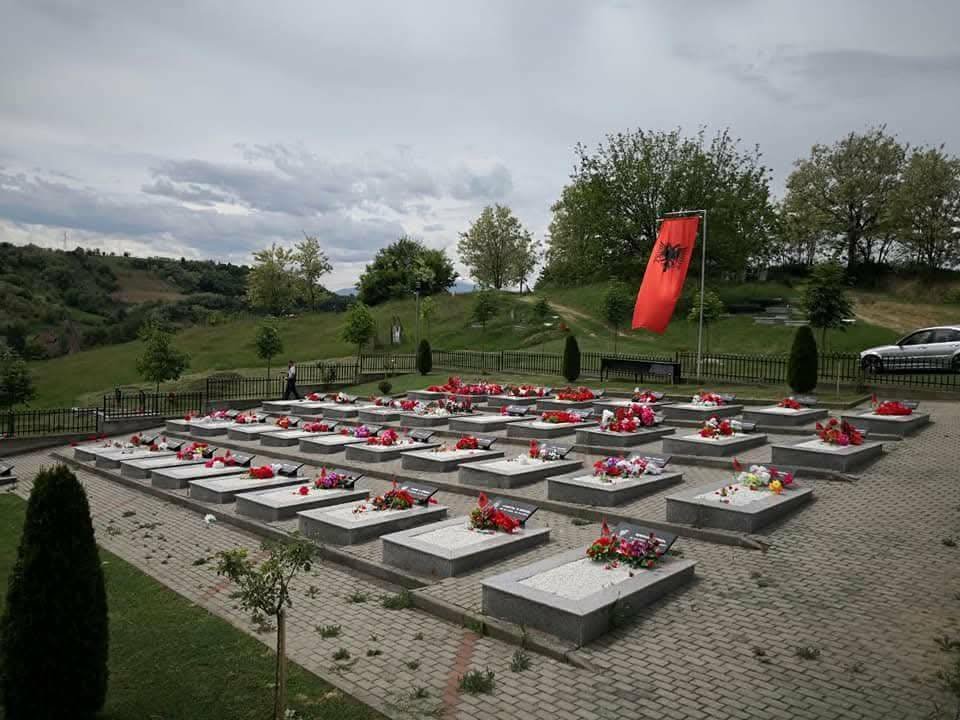
Around 19:45, March 24, 1999. A defining chapter in modern European history began: NATO’s intervention to stop the ethnic cleansing in Kosovo.
Exactly one year after the KLA’s epic resistance in Gllogjan, the democratic world launched its bombing campaign against Milošević’s criminal machinery. It was a difficult consensus, shaped by the liberal imperative to confront a “sovereignty” that was killing, abusing, massacring, and expelling civilians.
Today, on the 27th anniversary of the battle against genocide, the struggle against Serbian “victimhood narratives” has become even more challenging.
A truth recognized worldwide continues to be distorted by a reversed Serbian narrative: Racak as a “staged event”, NATO as the “aggressor”, and Serbia as the “victim”.
Western powers had been informed about the ethnic cleansing plan (Operation “Horseshoe”). Chancellor Gerhard Schröder described it as a state strategy for the expulsion of Albanians, while Javier Solana declared that intervention had become inevitable after the failure of diplomacy.
No matter how aggressive or sophisticated Serbia’s denial may be, the facts remain undeniable: nearly one million Albanians expelled, over 13,000 killed, around 20,000 women raped, and hundreds of villages, towns, and cultural monuments destroyed—clear evidence of the intent behind “Horseshoe”.
Around 03:30 in the morning, tanks and armored military vehicles entered Bellacërkë (today Fortesë).
From the hill, police units opened fire on the village to intimidate and drive away the residents. The encirclement followed. Forces advanced from the main road toward the stream, through which many residents had fled toward Rogovë, for nearly a kilometer, closing the circle near Bellaja.
By 09:30, the brutality escalated: looting, orders to strip, insults, shouts of “Where is NATO?”, civilians pushed toward the river, and finally, gunfire from all directions.
Dardani (6), Ardiani, Kreshniku… along with 65 other civilians, were killed by the bullets of Zllatko Bozanic (Opterushë), Dejan (Xërxë), and their associates—wearing mixed uniforms, some police blue and others military camouflage (according to the testimony of F.P., a survivor) (U.S. Department of State, 1999).
They are still waiting for justice, as none of the perpetrators have been convicted.
The genocidal pattern then continued toward Celinë—75 killed.
In Brestoc, the plan had already been executed: 45 massacred.
In Hoçë e Vogël (from March 25 to April 2), 34 civilians were killed, including 14 children aged between 6 months and 16 years.
Meanwhile, Serbian forces had surrounded Krusha e Madhe and Krusha e Vogël.
Following heavy shelling, special infantry units began burning and looting. Women and children were separated (and ordered toward Albania), while men and boys were gathered at the mosque and other locations.
Personal documents were confiscated to erase identities, followed by brutal beatings, executions one by one, and volleys of gunfire against groups of civilians. In the end, bodies were burned and thrown into the Drini River to conceal the evidence. 241 were killed, with 64 graves still unnamed.
A similar scenario unfolded in Krusha e Vogël, where Serb residents also lived. Some local Serbs assisted in the execution of all Albanian men. The village was left to the “women in black,” after the massacre and burning of the bodies of 113 men and boys.
The Shadow of Denied Crime
The crimes of Serbian forces do not end with bullets fired at children, women, and the elderly. They continue to be held hostage by injustice and denial, buried beneath the ashes of the burned and the fate of the missing.
Bellacërkë, Celinë, Brestoc, Krusha… are not merely toponyms of pain.
They are testimonies of a genocidal plan and terror against civilians following the decisive intervention of the “allied force.”
Milosevic realized that his end was approaching; therefore, the coordinated campaign of “Horseshoe” was a calculated attempt to “kill two birds with one stone”: a Kosovo without Albanians (through monstrous crimes aimed at making forced displacement irreversible) and the blaming of NATO (portraying international intervention as the cause of the catastrophe).
The plan failed, as military intervention was not the only international response.
The deported population was not scattered across the world; instead, Albania, Macedonia, and Montenegro became strategic corridors for return.
Yet the crime remained. Fortesë, Celinë, Brestoc, Krusha—and all of Kosovo—continue to bear witness, commemorating each year the pain that is denied.
Instead of reflection, Serbia temporarily retreated behind Milosevic in The Hague.
It never repented and never apologized. On the contrary, it attempted to conceal, deny, and continues to attack while claiming victimhood.
Vucic, along with prosecutors, academics, and clerics aligned with him, has called Racak a “staged event to justify NATO’s intervention,” labeled Srebrenica a “tragic incident”, and remains silent on Bellacërkë, Celinë, Brestoc, Krusha e Madhe, Krusha e Vogël…
They seek to blame NATO, the United States, the United Kingdom, Germany, and France, while continuing hybrid aggression through narratives of victimhood.
Through the DARVO strategy (Deny, Attack, Reverse Victim and Offender), they attempt to evade responsibility by reversing roles and presenting themselves as victims.
Therefore, the shadow of crime (Under Orders: War Crimes in Kosovo, Human Rights Watch, 2001) is not a metaphor—it is a strategy. A pernicious strategy aimed at manipulating the truth by fabricating narratives of “terror, discrimination, and existential threat” against Serbs in Kosovo.
That is why, even today, in the face of propaganda whose objective is FORGETTING, Krusha, Bellacërkë, Celinë, Hoça, Brestoc… continue to demand JUSTICE.