

In the digital context of information warfare, propaganda requires greater sophistication and emotional stimulation. Serbia’s strategy of “victimization” uses false attribution, “mirror accusations,” and the fabrication of threats, aiming to manipulate the truth. Through projection and amplification in the media, its strategic communication consists of internal mobilization, international confusion, and NATO’s alleged “mistake,” with the purpose of legitimizing its militarization and undermining the Republic of Kosovo.
False Attribution for Greater Effect
At a time when the United States is making the path toward peace in the Balkans clearer through Kosovo’s integration into NATO, Serbia falsifies the statements of an American in order to strengthen its anti-NATO narrative. Reporting on the latest “Perspektivat” podcast by Cedomir Antic on K1, featuring former U.S. Ambassador to Serbia William Montgomery and his wife Lynn, Blic.rs falsely attributed positions to him through the headline: “We All Made Mistakes: William Montgomery on NATO Bombing and Kosovo.” This article, later amplified by other Serbian media outlets, nowhere in its text contains such a statement by the former ambassador, who clearly identifies Milosevic as responsible.
“His nationalist rhetoric with the famous statement ‘No one dares touch you,’ the removal of autonomy, the closure of schools, and the repression against Albanians are the reasons that later led to guerrilla warfare,” the ambassador stated, while describing as “madness” the statement of U.S. envoy Gelbard, who had labeled the KLA a “terrorist organization” (23.02.1998).
Montgomery also recounted his unsuccessful efforts at the time, as well as the Raçak massacre, which quickly spread worldwide and ultimately led to the beginning of the bombings. He called this a “bad outcome” in the context of the failure of international efforts to stop Milosevic. Bombs as a last resort, not as an “injustice” or an admission of wrongdoing.
Therefore, the headline “We All Made Mistakes” represents a strategic framing of the conversation with the American diplomat, using false attribution in the service of confusion and public perception regarding Serbia’s alleged “rightness,” supposedly now being “acknowledged” even by the Americans themselves.
This is a byproduct of Serbia’s strategic communication within the framework of “victimization,” which uses the “injustice of the West” to absolve itself of responsibility for crimes and genocide in Kosovo.
Fabricating the “Threat” in Prishtina
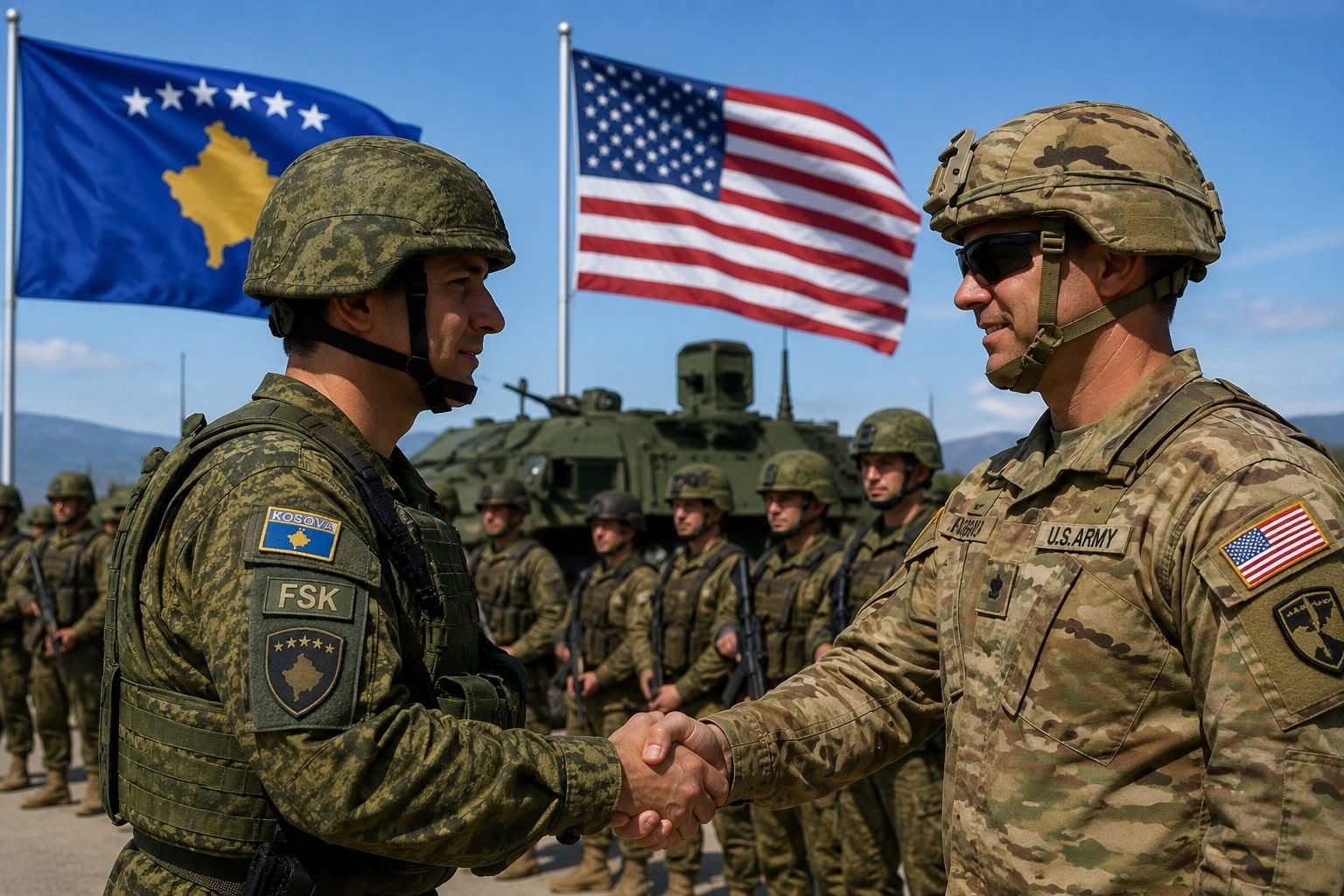
The narrative of NATO’s former “aggression” and the current “threat” from the Kosovo-Albania-Croatia alliance is further refined by disregarding two NATO member states and sounding the alarm that “Prishtina is waiting for the signal to begin aggression” against Serbia. Framing the strengthening of the Kosovo Security Force’s (KSF) military capacities as “militarization carried out for years by Recep Tayyip Erdogan,” Politika journalist Dejan Spalovic concludes that “offensive actions are being prepared once they receive the ‘green light’ and international circumstances allow it.”
He “bases” this on the military financial cooperation agreement (Telegrafi, 05.05.2026), as a continuation of the framework agreement (Anadolu Agency, 02.04.2024) that enabled strategic investments, other bilateral agreements (without specifying them), the participation of the KSF in international missions, and the increase of the military budget, labeling them all as a “growing threat to peace.” He knows that his analysis has no basis, but political objectives require such an interpretation.
As the newest product of the “victimization” strategy, Spalovic’s alarmism aims to divert the truth about independent Kosovo, camouflage Serbia’s militarization (primarily by Russia and China), and encourage the nationalist mobilization of public opinion. Outside the long-standing anti-NATO framework, now supplemented with the “threat” of Serbia’s “encirclement,” his approach would simply reflect desperation. However, according to the logic of “mirror accusations,” which explains Serbia’s hidden intentions, such messaging signals the troubling proximity of danger.
A journalist sounds more “neutral” in such cases, despite deliberately “forgetting” that Kosovo is a sovereign state confirmed by the International Court of Justice (ICJ, Advisory Opinion, 22.07.2010); that Resolution 1244 remains hostage to geopolitical rivalries in the Security Council and is exploited by Serbia as a tool to keep the issue “open” at the UN (Asllani, 2025); and that the KSF is a NATO-standard military force, regarded as a factor of peace alongside allies in international missions and also supplied by the United States (Radio Evropa e Lirë, 14.05.2026). Yet the role of the U.S. in this alleged “militarization” is mentioned nowhere in this “analysis.”
This means that Serbia’s strategic communication has projected yet another dimension through Turkey and President Erdogan: the subtext of an “Islamic threat” as an element for emotional and religious incitement. Nevertheless, Spalovic’s conclusion that “Kosovo is waiting for the signal” is merely a sharpened repetition of Vucic’s recurring narrative that “they are waiting for the right moment” (B92, 12.03.2026). It is a “journalist” striking at NATO’s other flank after attacking its core through yesterday’s fabrications made in the name of former U.S. Ambassador to Serbia, William Montgomery.