

Gjon Culaj, Associate Fellow at the “Octopus” Institute
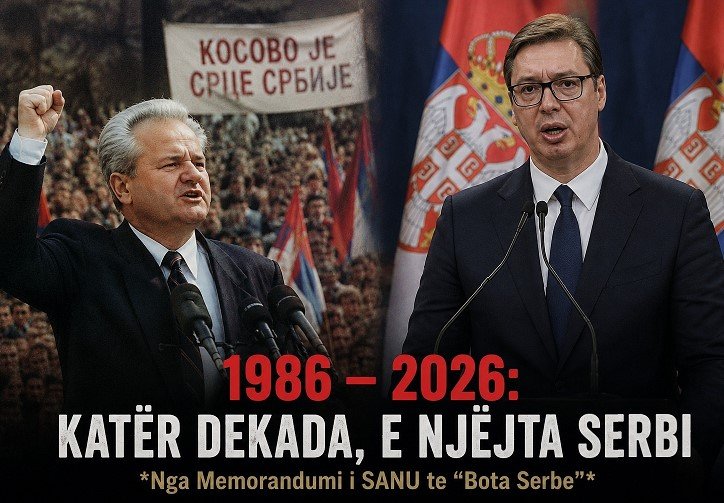
Four decades after the Memorandum of the Serbian Academy of Sciences and Arts (SANU), the question that still merits attention is: how does Serbian nationalism conceive Kosovo, Serbs outside Serbia’s borders, and the country’s role in the region? The answers reveal a concerning continuity.
The political history of Serbia over the past four decades reflects both changes in political regimes and the persistence of core nationalist narratives. From socialist Yugoslavia to today’s Serbia, leaders, institutions, alliances, and the tools of policy have changed. However, one element has remained entirely unchanged: the way the majority of the Serbian political elite has treated Kosovo and the issue of Serbs outside Serbia. According to Aidan Hehir, the Kosovo myth and the symbolic framework of Serbian nationalism, consolidated during the nineteenth century, were revived and instrumentalized by Serbian nationalists in the 1980s, while Slobodan Milošević and his regime used this narrative to mobilize political support, portraying Serbs particularly those in Kosovo as a community facing an existential threat (Hehir, 2026: 2). Hehir argues that the Serbian government’s current statements regarding the “ethnic cleansing” of Serbs in Kosovo are not merely reactions to contemporary developments. According to him, they are connected to a longer tradition of Serbian nationalism in which Kosovo Serbs are repeatedly portrayed as a threatened community and as victims of a broader danger to Serbia. This way of portraying Kosovo, according to Hehir, has its roots in Serbian nationalism that developed during the nineteenth century and was revived and politically exploited by Slobodan Milošević in the 1980s. In this sense, today’s narrative about the situation of Serbs in Kosovo can be seen as a continuation, adapted to contemporary circumstances, of a nationalist narrative that has served as a tool for political mobilization in the past as well (Hehir, 2026:2, 13).
At the heart of this narrative lies victimhood: the idea that Serbs are constantly under threat, that Serbia is the victim of historical and international injustices, and that the Serbian state has a special role in “protecting” Serbs even beyond its own borders. This logically leads to the question: Is Serbia in 2026 the same as it was in 1986 or, what has changed in form, and what has remained the same in substance?
From Serbian Victimhood to State Nationalism
The loss of the war and of de facto control over Kosovo in 1999 did not mark the end of Serbian nationalism associated with Kosovo. On the contrary, it led to its transformation. Whereas during the 1980s and 1990s Serbian nationalism increasingly relied on mass mobilization, territorial control, and the use of force, after 1999 this nationalism took on an institutional and political form through the preservation of territorial claims, the non-recognition of Kosovo’s independence, support for parallel Serbian structures in Kosovo, the mobilization of international diplomacy, and the continued use of victimhood narratives. Following the withdrawal of Serbian and Yugoslav forces from Kosovo in 1999, Serbia lost direct control over the territory but did not abandon its political and constitutional claim to it. This created a new situation in which, although Belgrade could no longer exercise sovereignty over Kosovo as it had prior to 1999, it continued to maintain a significant presence and influence, particularly through its ties with the Serb community and parallel structures operating in Serb-majority areas.
The study by Van der Borgh and Lasance (2013) shows that after 1999, Serbian authorities began rebuilding Serbian institutions in parts of Kosovo where a significant Serb population lived. These structures created forms of parallel governance that maintained political, administrative, and financial links between Belgrade and the Serb community in Kosovo (Van Der Borgh & Lasance, 2013: 187). This development is important for understanding the transformation of state nationalism after 1999. Serbia was no longer able to control Kosovo through its security apparatus across the entire territory, but it maintained an indirect state presence through parallel institutions, financing, education, healthcare, and local structures. In his article “Resisting International State Building in Kosovo” (2012), Van Der Borgh argues that these institutions did not serve merely to provide services; they also had a political function: to strengthen the presence of the Serbian state in Kosovo and to challenge international recognition of Kosovo’s statehood and the consolidation of its institutions (Van Der Borgh, 2012: 35-36). In this sense, nationalism changed its instruments, but not necessarily its objective. The primary objective remained the preservation of the link between Kosovo Serbs and the Serbian state and, more broadly, the preservation of the idea that Kosovo was not, and is not, a foreign state, but a territory that Serbia continues to consider as an integral part of itself. This is why nationalist discourse has real consequences. When a community is constantly portrayed as being under threat, a territory is framed as having been unjustly taken away, and the state defines its political role around the “protection” of that community, the distinction between political rhetoric and nationalist mobilization becomes increasingly blurred.
Recent studies on Serbian political discourse after 2022 indicate that historical memory and victimhood narratives continue to play an important role in the way Serbia’s political elites interpret and legitimize the situation in Kosovo. According to Ismaili and Marleku (2026), Serbian political elites have selectively employed elements of narratives of resistance, victimhood, martyrdom, and “defensive war” to portray the Serb community in Kosovo as a threatened community, while presenting its political or armed actions as forms of legitimate resistance. The authors link this approach particularly to two developments: the coordinated withdrawal of Kosovo Serbs from the institutions in 2022 and the Banjska attack in 2023. According to them, these should not be viewed as isolated episodes, but rather as part of a broader strategy by Serbian elites to appropriate and reshape historical narratives in order to contest the political legitimacy of Kosovo (Ismaili & Marleku, 2026). Thus, collective memory and narratives of victimhood become powerful political instruments, shaping interpretations of the past while legitimizing todays tensions, political agendas, and actions.
“The Serbian World”: A New Name with Old Aims
Over the last decade, the idea of a “Serbian World“ has gained increasing prominence. In political and cultural discourse, the idea seeks to promote stronger ties among Serbs in Serbia, Bosnia and Herzegovina, Montenegro, Kosovo, and other countries across the region (Horák & Čermák,2026:5). For its supporters, this can be presented as a form of cultural, linguistic, and national interconnectedness. The problem arises when cultural interconnectedness is transformed into a project and instrument of Serbia’s regional policy. A study published in Pregled in 2025 explores Serbian nationalism as a regional challenge and argues that the contemporary policy of the “Serbian World” represents a rebranding of elements of the historical project of “Greater Serbia.” The study specifically identifies Bosnia and Herzegovina, Croatia, Montenegro, Kosovo, and North Macedonia as areas where this policy has the potential to generate tensions (Todorović, 2025:46). In this sense, a change in the name and presentation of a policy does not necessarily mean the disappearance of the objectives or narratives that existed in the past. On the contrary, they may re-emerge in a new political language and in forms more adapted to contemporary realities. This does not mean that every form of cultural connection among Serbs constitutes a threat. However, the history of the Balkans demonstrates that the boundary between culture and politics becomes problematic when a state in this case, Serbia maintains territorial claims while challenging the sovereignty of neighboring countries. From this perspective, the “Serbian World” can be understood not merely as a political or identity-based slogan, but as a broader project aimed at preserving and expanding Serbian influence in the region. According to Arben Fetoshi (2025), this project is closely linked to nationalist narratives, ethnic mobilization, and the use of information warfare, emerging as a factor that can negatively affect security, stability, and interethnic relations in the Western Balkans (Fetoshi, 2025).
It is important to note that the “Serbian World” draws clear parallels with Russia’s Russkiy mir (“Russian World”), particularly in its use of shared linguistic, cultural, religious, and national ties to construct a broader sphere of influence extending beyond Serbia’s territorial borders. Dimitar Bechev (2023), in his article “Hedging Its Bets: Serbia Between Russia and the EU,” notes that Serbia’s network of formal and informal ties across the region bears similarities to Russkiy mir, describing the “Serbian World” as a space through which Serbia exercises influence beyond its borders. Furthermore, the author emphasizes that this approach is perceived as potentially connected to Serbian revanchism, turning it into a destabilizing factor for regional security and stability (Bechev, 2023). In this sense, the “Serbian World” should not be viewed as an idea that suddenly emerged only a few years ago. The name is relatively new, but the elements it encompasses are much older. The main change lies in the way the idea is articulated. Instead of an explicit claim for the territorial expansion of Serbia, the focus is placed on the “unity of the Serbian people,” the protection of identity, and the preservation of cultural and political ties.
Nevertheless, the historical continuity cannot be ignored. From Garasanin’s Načertanije, through twentieth-century nationalism and up to the discourse of the “Serbian World,” there is a recurring idea that the Serbian nation extends beyond the borders of the Republic of Serbia and that Belgrade has a special role in preserving its unity (Ljubomirović, 2024:135-140). This does not mean that all these projects are identical, but it does point to a particular line of continuity in Serbian political thought. In a broader context, such a policy can deepen ethnic divisions and create new tensions in a region that remains fragile. Therefore, the “Serbian World” should be viewed not only as an identity-based concept, but also as a potential threat to regional peace. If 1986 marked the beginning of a period in which victimhood and the Kosovo issue were placed at the center of Serbian nationalist mobilization, four decades later, unfortunately, these narratives have not disappeared. Their continuity remains deeply concerning and represents an ongoing challenge to peace and security in the region.